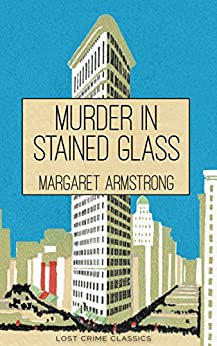
Miss Trumbull, a wealthy Park Avenue spinster, is visiting her old school friend Charlotte and her niece Phyllis in the Connecticut countryside. Phyllis is engaged to the handsome Leo Ullathorne. However, their wedding date is still not set due to Leo’s dire financial straits as only a junior partner for his famous father, Frederick Ullathorne’s prominent glass-making firm. Rumors swirl around the small town that Frederick Ullathorne will not make Leo a full partner in the glass-making firm because he is in love with Phyllis.
Trouble for Leo and Phyllis abounds when Frederick Ullathorne disappears and is presumed dead when skeletal fragments are found in his glass firing kiln. Leo stands to inherit his father’s fortune and business. However, Leo and Phyllis cannot wed until his name is cleared, and Miss Trumbull will stop at nothing to get Leo’s name and get these two love birds married.
The Review
Murder in Stained Glass is the only Miss Trumbull mystery, and that’s a shame because she’s an interesting protagonist: wealthy, fun-loving, well connected, she knows how to get people to talk without being snoopy. She’s also intelligent and a little foolhardy, going into danger alone and traveling great distances to get the merest scrap of information. She seems motivated by love more than justice and has many resources and money at her fingertips, so I think she could have been a great protagonist in future novels. Alas, Murder in Stained Glass is Margaret Armstrong’s only book with her.
The book is a bit uneven, the beginning ponderous and slow, but the prose is light, so it’s easy to keep reading. The book is short, so there are moments where the prose is sparse and could use some fleshing out, especially when Miss Trumbull is traveling from place to place.
The characters are interesting; the intrepid Miss Trumbull is looking for the killer of Frederick Ullathorne, a brash, mean old cuss whose artistic eye and forthright manner leave people angry and endeared to him in equal measure. He is hated and missed in equal regard, and the more Miss Trumbull digs into his past, the more compelling of a character he becomes. Miss Trumbull seems at home in a morally gray area, especially when protecting the people she loves, which is a nice twist on the uptight, justice-mongering harbinger that is the likes of Miss Marple.
The plot is really clever, and I was surprised at the motive for the crime, even if the murderer was not too difficult to work out. The high-octane final scene, where the murderer is apprehended and the police detective, who has a light touch in the book, quickly unmasks that he has not been fooled by Miss Trumbull and her escapades, is a grand reveal.
I just wish there was more. More to the story, more of Margaret Armstrong’s beautiful illustrations (she was a well-known illustrator and illustrated the cover–which strangely has nothing to do with the book), more of Miss Trumbull, more of Margaret Armstrong’s vivid appreciation for glass-making, and painting since she obviously knows so much about it because her father was a stained glass artist. Margaret Armstrong weaves excellent storytelling, and then paragraphs, characters, and locations sputter to a close. I want more, but there isn’t. Everything in Murder in Stained Glass is left a little bereft, and it’s disappointing because I think subsequent books would have evened out the shortcomings of Murder in Stained Glass.

 Golden Age of Detective Fiction
Leave a comment