
As an avid fan of classic television mysteries, I recently had the pleasure of delving into the enigmatic world of “Colonel March of Scotland Yard” which is available for free on Amazon Prime while recovering from surgery.
This British television program which ran for one series and consisted of 26 half-hour shows, follows the exploits of Colonel March, played with charismatic sophistication by Boris Karloff, as he tackles perplexing cases for Scotland Yard’s Department of Queer Complaints which is based on a book, The Department of Queer Complaints by Carter Dickson which was published in 1940. This book is a collection of eleven short stories, seven starring Colonel March.

Set against the backdrop of post-war London, each episode of “Colonel March” presents a new puzzle for viewers to unravel alongside the sharp-witted Colonel. The series focuses primarily on locked room mysteries, with horror, sci-fi, and paranormal elements flavoring several episodes, which are the specialty of Carter Dickson. From stolen artifacts to baffling murders, the series offers a captivating blend of suspense, intrigue, and intellectual challenge.
One of the standout elements of “Colonel March” is its emphasis on cerebral deduction over action-packed sequences. Unlike many contemporary crime dramas, the focus here is firmly on the unraveling of clues and the exploration of motive. This makes for a refreshing change of pace, allowing the audience to engage fully with the intricacies of each case.
Another aspect that sets “Colonel March” apart is its atmospheric cinematography and evocative set designs. The shadowy alleyways of London and the grand interiors of stately homes provide the perfect backdrop for the Colonel’s investigations, adding to the overall sense of mystery and suspense.

The series also boasts several sci-fi set pieces fit for B- -movies and plenty of aliens (episode 10) and abominable snowmen (episode 2) in cheesy costumes. If you are a 50s horror and sci-fi fan, you’ll love these spook of the week episodes th(at pepper the series. The late, great Christopher Lee, a titan of the horror genre lends his gravitas to his character JeanPierre in episode 4: All Cats Are Grey. Sadly, The episode boasts no horror or science fiction elements but has a great locked room mystery where Colonel March must discover who killed a beautiful French model.

Of course, no discussion of “Colonel March” would be complete without mentioning Boris Karloff’s commanding performance in the title role. With his distinctive voice and imposing presence, Karloff imbues Colonel March with a combination of intelligence, charm, and gravitas that makes him utterly compelling to watch.
Colonel March is also joined in 21 episodes by Inspector Amers, played by Ewan Roberts. Roberts has an amiable relationship with March, and they work in tandem to catch villains. My favorite episode, Present Tense, features the two of them trying to catch a ghost. In the episode, Colonel March’s niece, Mary’s husband, died sometime previous to the series in a plane crash. However, Mary swears she can hear her husband’s voice once kindly; this spectral voice is now menacing and torturing her every night. Inspector Ames cleverly follows up every lead to make sure her husband is really in his grave.

“Colonel March of Scotland Yard” is a captivating television series that offers a delightful blend of a traditional mystery with horror and sci-fi atmosphere and compelling characters. Whether you’re a fan of classic whodunits, especially of the locked room subgenre, or enjoy a good detective story, this hidden gem is well worth seeking out.
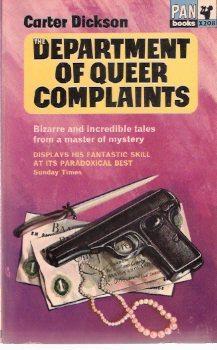
The Department of Queer Complaints by Carter Dickson (1940)
Goodreads Synopsis:
It The New Invisible Man; Footprint in the Sky; The Crime in Nobody’s Room; Hot Money; Death in the Dressing Room; The Silver Curtain; Error at Daybreak, these 7 stories are all Colonel March mysteries, as well, this collection The Other Hangman; New Murders for Old; Persons or Things Unknown; Blind Man’s Hood, this book reprints the contents of the original hardcover edition which contained these 11 stories (of which 4 are NOT Colonel March stories)


Carter Dickson Reviews
Sir Henry Merrivale #1: The Plague Court Murders (1934)
Sir Henry Merrivale #10: And So To Murder (1940)
John Dickson Carr Reviews
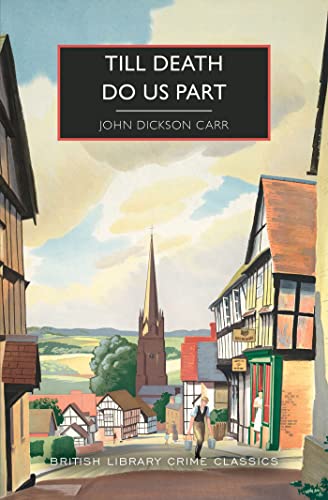
Dr. Gideon Fell #15: Till Death Do Us Part (1944)

Carter Dickson Biography
Carter Dickson is the pen name of John Dickson Carr, a prolific and highly acclaimed author of detective fiction, particularly known for his locked room mysteries and impossible crime stories. Born on November 30, 1906, in Uniontown, Pennsylvania, Carr grew up with a love for literature and mystery novels.
After completing his education at Haverford College and earning a master’s degree in French literature from the University of Paris, Carr embarked on a career as a writer. He began his literary journey with his first novel, “It Walks by Night,” published in 1930, which introduced readers to the eccentric detective Sir Henry Merrivale, also known as “H.M.” or “the Old Man in the Corner.”
Throughout his career, Carr wrote over 70 novels and numerous short stories, earning him a reputation as one of the masters of the Golden Age of Detective Fiction. His works are celebrated for their intricate plots, clever puzzles, and atmospheric settings, often featuring impossible crimes that challenge both the detective and the reader’s intellect.
Some of Carr’s most famous works include “The Hollow Man” (1935), also known as “The Three Coffins,” which is regarded as one of the finest locked room mysteries ever written. Other notable titles featuring Sir Henry Merrivale include “The Judas Window” (1938), “The White Priory Murders” (1934), and “Death in Five Boxes” (1938).
In addition to his Sir Henry Merrivale series, Carr also wrote under the name Carter Dickson, featuring the detective Sir Gervase Chevenix-Gore in several novels, including “The Bowstring Murders” (1933) and “The Punch and Judy Murders” (1936).
Carr’s contribution to the mystery genre was honored with numerous awards, including the prestigious Mystery Writers of America’s Grand Master Award in 1963. He continued to write until his death on February 28, 1977, leaving behind a legacy of classic detective fiction that continues to captivate readers and inspire writers to this day.


 Golden Age of Detective Fiction
Leave a comment