
Happy April Fool’s Day! I’m not pulling any tricks or pranks today, but I am excited for this month’s TBR which is completely British Library Crime Classics themed.
The British Library Crime Classics series has roughly 95 vintage British mysteries in int’s catalogue. Each comes with a fantastic introduction and many of the titles have been out of print for many years before being resurrected by this popular imprint of The British Library.




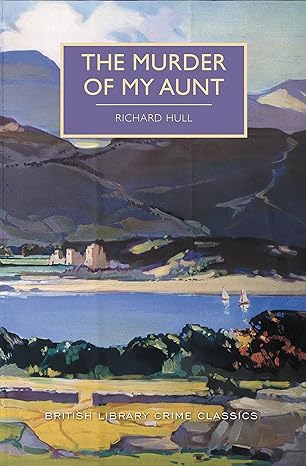





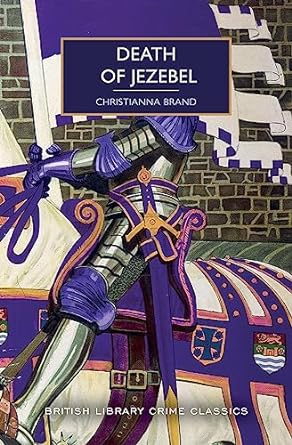


My collection of British Library Crime Classics is a little overgrown. I have 29 books (excluding short story collections) that I haven’t reviewed from the series languishing on my shelves, so I will try to read as many as possible this month. I’m using a random number generator to pick my reads to keep me from reading all of the E.C.R. Lorac books and calling it a successful month. So, let’s see what I’m reading this month!
Book #1: Weekend at Thrackley by Alan Melville (1934)

Goodreads Synopsis:
WITH AN INTRODUCTION BY MARTIN EDWARDS
‘I’m taking a revolver to Thrackley. You never know with blokes like Carson. I hate these harmless, potty people – they’re always up to something.’
Jim Henderson is one of six guests summoned by the mysterious Edwin Carson, a collector of precious stones, to a weekend party at his country house, Thrackley. The house is gloomy and forbidding but the party is warm and hospitable – except for the presence of Jacobson, the sinister butler. The other guests are wealthy people draped in jewels; Jim cannot imagine why he belongs in such company.
After a weekend of adventure – with attempted robbery and a vanishing guest – secrets come to light and Jim unravels a mystery from his past.
Book #2: The Widow of Bath by Margot Bennett (1952)
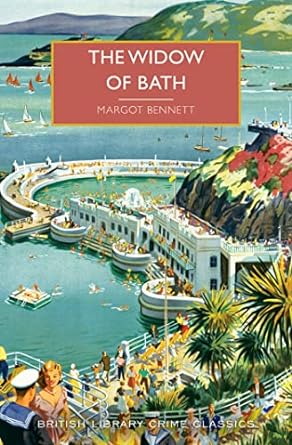
Goodreads Synopsis:
First published in 1952, The Widow of Bath offers intricate puzzles, international intrigue, and a richly evoked portrait of post-war Britain, all delivered with Bennett’s signature brand of witty and elegant prose. This edition includes an introduction by CWA Diamond Dagger Award-winning author Martin Edwards.
Hugh Everton was intent on nothing more than quietly drinking in the second-rate hotel he found himself in on England’s south coast―and then in walked his old flame Lucy and her new husband and ex-judge, Gregory Bath. Entreated by Lucy to join her party for an evening back at the Bath residence, Hugh is powerless to resist, but when the night ends with the judge’s inexplicable murder, he is pitched back into a world of chaos and crime―a world he had tried to escape for good.
Book #3: Murder in Piccadilly by Charles Kingston (1936)

Goodreads Synopsis
‘Scores of men and women died daily in London, but on this day of days one of them had died in the very midst of a crowd and the cause of his death was a dagger piercing his heart. Death had become something very real.’
When Bobbie Cheldon falls in love with a pretty young dancer at the Frozen Fang night club in Soho, he has every hope of an idyllic marriage. But Nancy has more worldly ideas about her future: she is attracted not so much to Bobbie as to the fortune he expects to inherit.
Bobbie’s miserly uncle Massy stands between him and happiness: he will not relinquish the ten thousand a year on which Nancy’s hopes rest. When Bobbie falls under the sway of the roguish Nosey Ruslin, the stage is set for murder in the heart of Piccadilly – and for Nancy’s dreams to be realised. When Chief Inspector Wake of Scotland Yard enters the scene, he uncovers a tangled web of love affairs, a cynical Soho underworld, and a motive for murder.
The good-natured vintage mystery novel is now republished for the first time since the 1930s, with an introduction by the award-winning crime writer Martin Edwards, the leading expert on inter-war detective fiction.
Book #4: Death Has Deep Roots by Michael Gilbert (1951)
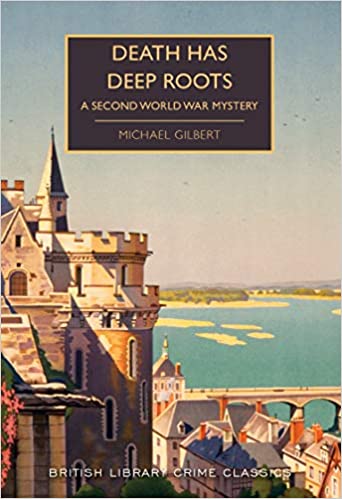
Goodreads Synopsis:
An eager London crowd awaits the trial of Victoria Lamartine, hotel worker, ex-French Resistance fighter, and the only logical suspect for the murder of her supposed lover, Major Eric Thoseby. Lamartine—who once escaped from the clutches of the Gestapo—is set to meet her end at the gallows.
One final opportunity remains: the defendant calls on solicitor Nap Rumbold to replace the defence counsel,and grants an eight-day reprieve from the proceedings. Without any time to spare, Rumbold boards a ferry across the Channel, tracing the roots of the brutal murder back into the war-torn past.
Expertly combining authentic courtroom drama at the Old Bailey with a perilous quest for evidence across France, Death Has Deep Roots is an unorthodox marvel of the mystery genre.
Book #5: The Chianti Flask by Marie Belloc Lowndes (1935)

Goodreads Synopsis:
An enigmatic young woman named Laura Dousland stands on trial for murder, accused of poisoning her elderly husband Fordish. It seems clear that the poison was delivered in a flask of Chianti with supper, but according to the couple’s servant in the witness-box, the flask disappeared the night Fordish died and all attempts to trace it have come to nothing. The jury delivers its verdict, but this is just the end of the beginning of Marie Belloc Lowndes’ gripping story. First published in 1934, this exquisitely crafted novel blends the tenets of a traditional mystery with an exploration of the psychological impact of death, accusation, guilt and justice in the aftermath of murder.
Book 6: Death of Jezebel by Christianna Brand (1948)

Goodreads Synopsis:
At Elysian Hall, a grand exhibition space in post-War London, a cast has been assembled for a medieval-themed pageant show featuring knights in colored armor, real horses, and a damsel in a rickety tower on high. With death threats discovered by members of the troupe before the show, the worst comes to pass when the leading lady is thrown from the tower before the eyes of the audience by an unknown assailant―with all doors backstage also under observation. Faced with a seemingly impossible case, the wizened Inspector Cockrill and the fresh-faced Inspector Charlesworth begrudgingly join forces to uncover the killer hiding in plain sight. First published in Britain in 1949, Brand’s exuberant novel is still regarded as one of the great masterpieces of the classic mystery genre for its fiendishly constructed puzzle, memorable setting, dumbfounding acts of misdirection and thrilling denouement. This edition includes an introduction by award-winning author Martin Edwards.
Book#7: The Murder of My Aunt by Richard Hull (1934)

Goodreads Synopsis:
Edward Powell lives with his Aunt Mildred in the Welsh town of Llwll. His aunt thinks Llwll an idyllic place to live, but Edward loathes the countryside – and thinks the company even worse. In fact, Edward has decided to murder his aunt.
A darkly humorous depiction of fraught family ties, The Murder of My Aunt was first published in 1934.
My thoughts: The Good
I am probably most excited to read The Weekend a Thrackley because it seems the most approachable and comfortably within my wheelhouse. I love a good country house murder with a closed circle of suspects.
I am also looking forward to reading Richard Hull’s The Murder of My Aunt due to the promised Wodehouse-like prose and the villain’s affable, if irascible, nature. I am interested in this inverted mystery with a twist and hope it lives up to the hype.
I am thrilled that Death of Jezebel is on my TBR this month. The jousting theme piques my interest, and I am keen to see how this setting lends itself to the oft-written hapless theatre troupe full of romance and intrigue that leads to murder. I am curious if this will give me a better sense of Inspector Cockrill, who, in my last encounter with him, was on holiday on a remote island and had to rely on his fellow travelers for assistance instead of the might of the police force.
My Thoughts: The Indifferent
I am a real blank slate on reading The Widow of Bath and after reading the Goodreads blurb, nothing really stands out to me. I think so much of my enjoyment of the story will depend on how deeply I connect with ex-rogue Hugh Everton. I find love triangles are an oft used trope in mystery novels to pad the story and create unneccesary situational “comedy”. However, a good love story can really create tension and emotional stakes for the reader. I am hoping to be impressed by The Widow of Bath.
Murder in Piccadilly on the face of it sounds like The Murder of My Aunt without the humor. A weak-willed young man get’s caught up with a bad crowd in Soho and has to kill his uncle to secure the affection of a showgirl. Again, so much of this book depends the characterization of the lovesick Bobbie and his paramour, Nancy. I am not sure from the little blurb if I am supposed to want them to succeed in their murder or not. I guess I’ll find out.
My Thoughts: “The Bad”
I am not a lover of courtroom mysteries and rarely review them on my blog. That’s not to say they are wrong; they are just usually plodding and full of melodrama about whether a usually innocent victim of shoddy police work can be saved by finding the actual killer. It’s a subgenre that appeals to many- such as my husband, but I find them bland. The Chianti Flask promises the courtroom drama is only the beginning and that, at its core, it is a book that explores the psychological ramifications of being accused of a crime, which, I’ll be honest, sounds heavy and possibly tedious.
Death Had Deep Roots, a courtroom drama and World War II espionage thriller, combines two subgenres of mystery that do not attract me. However, I look forward to meeting Inspector Hazlrigg and digging into this complex police procedural, even if there are elements to the story that I find less interesting. I’m always looking for a book that can change my mind about my biases.
What do you think?
What do you think of these lucky dip choices? Are there any books I have in my British Library Crime Classics collection that you highly recommend?
My British Library Crime Classics Reviews








The Poisoned Chocolates Case by Anthony Berkeley (1929)
Mystery in the Channel by Freeman Wills Crofts (1931)
The Hog’s Back Mystery by Freeman Wills Crofts (1933)
Murder in the Basement by Anthony Berkeley (1934)
The Lake District Murder by John Bude (1935)
The Cornish Coast Murder by John Bude (1935)
The Santa Klaus Murder by Mavis Doriel Hay (1936)
Post After Post-Mortem: An Oxfordshire Mystery by E.C.R. Lorac (1936)
The Cheltenham Square Murder by John Bude (1937)
These Names Make Clues by E.C.R. Lorac (1937)
Antidote to Venom by Freeman Wills Crofts (1938)
Till Death Do Us Part by John Dickson Carr (1944)
Fell Murder: A Lancashire Mystery by E.C.R. Lorac (1944)
Murder by Matchlight by E.C.R. Lorac (1945)
Death on the Riviera by John Bude (1952)
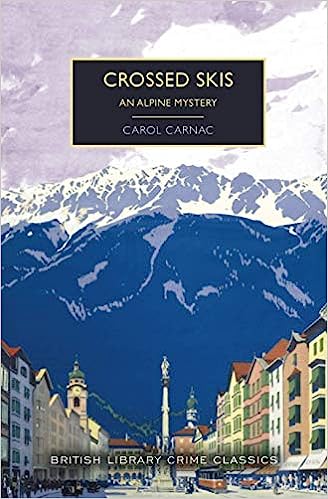
Crossed Skis by Carol Carnac (1952)
The Body in the Dumb River by George Bellairs (1961)
Murder by the Book, edited by Martin Edwards (2021)

 Golden Age of Detective Fiction
Leave a comment