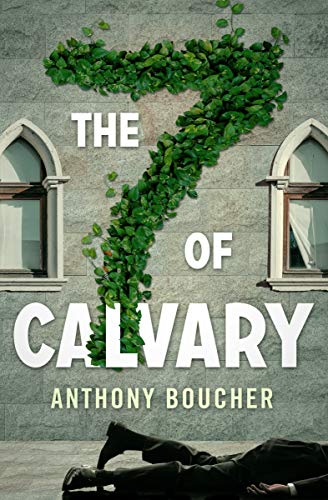
This book is published under the title: The Seven of Calvary in the USA and this is the version I read.
The Plot:
Dr. Ashwin, a professor of Sanskrit, and his student, Martin Lamb, act as a modern-day Holmes and Watson when Dr. Hugo Schaedel, a visiting lecturer from Switzerland, is stabbed through the heart with an ice pick outside student housing at night on the Berkley campus. The only clue left at the scene is a mysterious symbol on a scrap piece of paper by the body.
Rumors swirl around campus that Dr. Schaedel was killed by his nephew, a student on campus who badly needed money, or that he was targeted by an insular Swiss religious sect who disagreed with his lectures encouraging global peace as Europe turns its eyes towards war.
However, the rumors never predicted a second murder committed during the dress rehearsal of Martin Lamb’s translation of a Spanish Don Juan play. A student, unconnected with Dr. Schaedel, dies from a poisoned chalice.
Can Dr. Ashwin and Martin Lamb untangle the connection between these killings before a third person winds up dead?
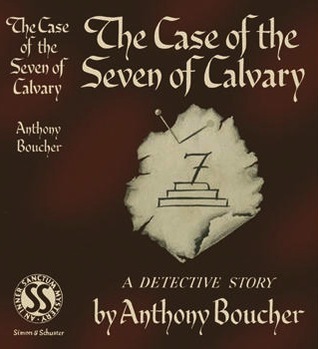
The Review
I originally picked this title to review for #1937club, which was held for a week during April; I contracted the stomach flu and could not post it, so here it is.
I am an avid classic science fiction reader and have read some of his works before, but this was my first proper mystery by Boucher, and it was nothing like I had expected. Let’s get the obvious out of the way- this story has no science fiction elements or tropes; it is detective fiction through and through.
The book begins with a clever discussion about the roles of Holmes, Watson, and the reader in detective fiction, which is a weakness for Martin Lamb and his mentor, Dr. Ashwin. This discussion seems like a pet subject between the pair, who are ostensibly working on translating ancient, which, as a side note- they do in the book- before Lamb goes to a university dinner and lecture that is held in honor and for Dr. Schaeder who is there to urge the students and faculty to implement peace talks as a buffer to rising nationalism and civil unrest.
After this lecture, the book wastes no time killing Dr. Schaedel outside Lamb’s crush’s house. Lamb’s friends and an eclectic mix of American and international students band together to investigate what happened to clear one of their own. However, they soon have reason to suspect each other and their professors for killing Dr. Schael.
Unfortunately, the mystery of the symbol was slightly spoiled for me, but I had a fun time waiting for Lamb to figure it out, which he could do with a bit of prodding as a student of languages.
However, just because he now knew what it said doesn’t mean he knew what it meant (a classic problem in translation), and when he hears of a strange Christian sect hiding its identity to carry out conspiracies like Dan Brown’s The Da Vinci Code…I was worried.
The book doesn’t go all The Da Vinci Code or “National Treasure” on us; it sticks much closer to home, with the deaths occurring for more tangible reasons—love and betrayal. Affairs of the heart weighs heavy on this book and motivates all seemingly unconnected deaths. To drive that theme home, a young man dies during his poetic monologue of Don Juan.
Knowing the story of Don Juan or even the musical The Man of La Mancha will aid you in figuring out the ever-triangulating relationships that seem to reconfigure after every chapter. There are so many competing motives from every angle that it’s hard to know when the reader is looking at everything the right way or up the garden path Boucher has cleverly set.
Students are in love triangles with students, students are in love triangles with professors, and people hide their true nature at every turn. Professor Ashwin works out the details in his office, aided by Lamb’s legwork. Everything is made clear in a Poirot-style gathering of the subjects in his home, where he unmasks everyone—another love letter to the detective genre.
The Seven of Calvary is an erudite mystery told as an oral history by Lamb to his friend. This modern take on Watson writing down the story in a collection for posterity is deftly done. I forgot that was how the book began until Lamb and his friend reminded us by having a brief, excited discussion before the third act. The book ends with the two friends discussing Lamb’s time as a “Watson.” This bookending technique is not used much in detective fiction but often in classical literature, incredibly epic poems.
Something I appreciated about this book is the accuracy of the translation. As a translator of Greek, German, French, and some Latin, I find the weaving of languages into the book ingenious, and the translations provided by the book are superb.
The international house Martin Lamb and his little band of friends live in is also actual to type—I lived in an international house during college. Let me tell you, there was a lot of drinking, smoking, and partying, with people bursting into rooms and doing whatever until everyone passed out, followed by hard studying during the day.
The book accurately describes a tight-knit relationship between a mentor and a mentee. From my student days and watching my husband mentor his students through their undergraduate courses, I know that what begins as a close study of vulcanology (in his case) often devolves into discussions b or c list horror movies like attracts like.
Okay, so I was tailor-made to love this book, but ultimately, it left a sour taste in my mouth, and I almost didn’t finish it.
TW: Pedophilia, R*pe, SA
Firstly, Dr. Ashwin is heavily modeled after Lewis Carroll, with Ashwin and Carroll having “closer friendships” with young girls. Ashwin has a “special friendship” with a young girl, and she is extra, extra special because he still likes being around her even though she is nine, and he usually doesn’t hang out with girls or women above the age of seven.
That whole storyline grossed me out so badly.
The weird relationships didn’t end with Dr. Ashwin, however. This is Martin Lamb musing on what his mystery book would be about:
“Some day, he should write a mystery novel in which the entire mystery should consist of such a question of paternity. Better yet, a mysterious rape. There could be a wonderful scene in which the crime was reconstructed, with the detective, as in conventional, performing the criminal’s actions.”
…..what the actual fuck….
Okay, so I hate both of the protagonists because they are horrible.
At that point, I had to google if Anthony Boucher was a r*pist or pedophile or something, and I didn’t find anything, but let’s just say I wouldn’t be surprised if I did.
R*pe and SA happen or happened to pretty much all of the young female students in the book. It is a matter of course. It is discussed by many of their male peers and boyfriends, like people discussing the weather. This book is profoundly misogynistic and disturbing on this subject.
There’s also an entire subplot that talks about abortion, with many of the female students utilizing this in 1937, which I imagine for the period was shocking. Frankly, the dehumanizing way it was depicted in the book was uncomfortable to read and might be triggering for some readers.
When I finished this book, I was so thoroughly uncomfortable I had to decompress with my husband verbally.
I don’t recommend The Seven of Calvary. It’s a clever mystery with much to say about the mystery genre, translation work, and life on college campuses. However, It also hates women and denigrates them at every opportunity. The two main characters are callous towards the suffering of others, especially women, and believe whatever horrible thing happens to others cannot get in the way of a good story.
I disagree- suffering happens in a mystery- but the reader should not be so removed from the story to think that because these aren’t “real people,” they don’t reflect or impact how we think about real people. I am unsure if Boucher intended us, the reader, to conflict with the “master detective,” given the discussion at the beginning of the hierarchy, or master detective over the reader, who is over Watson in intelligence. His original audience may not have been- social morays have moved much beyond 1937 and the attitudes presented in The Seven of Calvary. I was hoping this would be a forgotten gem, but it’s better left in the annals of history.
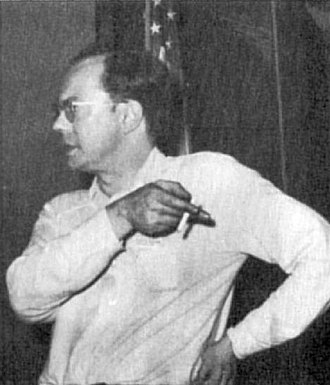
Anthony Boucher Biography
Anthony Boucher, born William Anthony Parker White (August 21, 1911 – April 29, 1968), was an American author, editor, and critic, best known for his contributions to the mystery and science fiction genres. Boucher was born in Oakland, California. He attended the University of Southern California, where he initially studied violin with the intention of pursuing a career in music. However, his interests soon shifted to writing and literature.
Boucher began his writing career in the 1930s, publishing mystery stories under various pseudonyms. He also became involved in science fiction fandom and started contributing to fanzines. In 1942, he co-founded “The Magazine of Fantasy & Science Fiction” (F&SF), a prominent science fiction magazine, and served as its editor until 1948. During his tenure, he helped shape the direction of science fiction literature and fostered the careers of many notable authors.
In addition to editing, Boucher continued to write mystery novels and short stories. He created the character of Fergus O’Breen, a detective featured in several of his mystery novels.
Boucher was also a respected critic and reviewer, known for his insightful analyses of both mystery and science fiction works. His reviews appeared in various publications, including “The New York Times” and “Ellery Queen’s Mystery Magazine.”


 Golden Age of Detective Fiction
Leave a comment