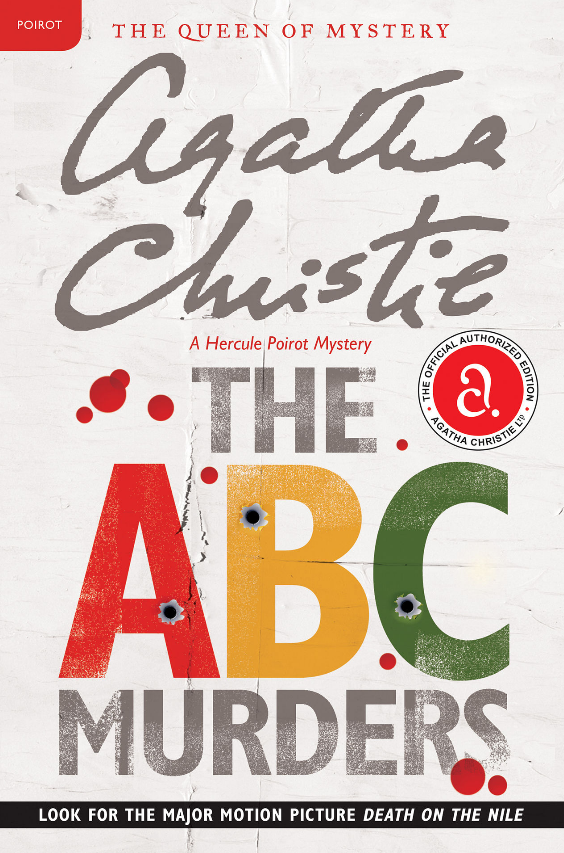
The ABC Murders by Agatha Christie was first published in the United Kingdom by Collins Crime Club on January 6, 1936. It was later released in the United States by Dodd, Mead, and Company in the same year.
Since its original publication, The ABC Murders has been reprinted numerous times and translated into various languages, cementing its status as a classic in the mystery genre. The novel has also been adapted for television, radio, and stage, including a notable 1992 adaptation as part of the British TV series “Agatha Christie’s Poirot,” starring David Suchet as Poirot. More recently, it was adapted into a three-part BBC miniseries in 2018, with John Malkovich portraying Poirot.
The enduring popularity of The ABC Murders highlights Agatha Christie’s masterful storytelling and her ability to craft intricate and compelling mysteries that continue to captivate audiences around the world.
The Plot
Upon returning to England from South America, Arthur Hastings reunites with his old friend, Hercule Poirot, at Poirot’s new flat in London. Poirot shares a mysterious letter he received, signed “A.B.C.,” which hints at an imminent crime, likely a murder. Soon, two more letters arrive, each preceding a murder committed by A.B.C. in alphabetical order: Alice Ascher, killed in her tobacco shop in Andover; Elizabeth “Betty” Barnard, a flirtatious waitress murdered on the beach at Bexhill; and Sir Carmichael Clarke, a wealthy man, slain at his home in Churston. In each case, an ABC Rail Guide is found beside the victim.
The investigation, led by Chief Inspector Japp, includes Inspector Crome, skeptical of Poirot’s skills, and Dr. Thompson, who profiles the killer. Poirot assembles a “Legion” of the victims’ relatives to gather information: Franklin Clarke, Sir Carmichael’s brother; Mary Drower, Ascher’s niece; Donald Fraser, Betty’s fiancé; Megan Barnard, Betty’s elder sister; and Thora Grey, Sir Carmichael’s assistant. During a meeting with the third victim’s widow, Lady Clarke, a crucial detail emerges: a man selling silk stockings was seen at or near each crime scene on the day of the murders. Poirot ponders why the letters were sent to him rather than the police or newspapers and why the third letter’s misspelling caused a delay in its delivery. A.B.C.’s following letter directs everyone to Doncaster, predicting the subsequent murder during the St. Leger Stakes race. Still, the killer strikes at a cinema instead, and the victim’s name doesn’t fit the alphabetical pattern.
The police received a tip about Alexander Bonaparte Cust, an epileptic traveling salesman suffering from memory blackouts and severe headaches due to a World War I head injury. Cust flees but collapses at the Andover police station, where he is arrested. He claims to have been hired by a stocking firm but has no memory of the murders, though he believes he is guilty since he found blood on his sleeve and a knife in his pocket after the cinema murder. The police discover the firm never hired Cust, and a search of his room reveals an unopened box of ABC railway guides, the typewriter, and fine paper used for A.B.C.’s letters. Poirot doubts Cust’s guilt due to his memory blackouts and his solid alibi for the Bexhill murder.
At a Legion meeting, Poirot declares Cust innocent and reveals the killer committed these murders to throw investigators off the scent of the crime and obscuring their deeply personal motive behind killing one of the victims dramatically.
The Review
I recently finished reading The ABC Murders by Agatha Christie, and I’d give it a solid 3.5 stars. As a fan of classic mysteries, I found the plot intriguing and cleverly constructed, but with several story elements that I did not enjoy.
The story starts with Arthur Hastings returning from South America and reuniting with his old friend, Hercule Poirot, in London. Poirot has received a cryptic letter signed “A.B.C.,” warning of an imminent crime. This letter is just the beginning, as two more follow, each one arriving before a murder is committed in alphabetical order.
The victims are Alice Ascher in Andover, Elizabeth “Betty” Barnard in Bexhill, and Sir Carmichael Clarke in Churston, with an ABC Rail Guide left beside each body. Poirot’s sharp intellect is tested as he collaborates with Chief Inspector Japp and a skeptical Inspector Crome while forming a “Legion” of the victims’ relatives to gather clues.
I particularly enjoyed the diverse cast of characters, from the grieving relatives to the mysterious Alexander Bonaparte Cust, whose memory blackouts and wartime injuries make him a prime suspect. I also enjoyed that Cust was written as the opposite of the usual soldier, usually written as the story’s hero. Still, he was portrayed as physically weak and as an easily duped victim who was kind to the wrong person.
Poirot’s methodical approach and attention to detail regarding Cust and his convoluted meanderings as a stocking salesman kept me guessing throughout as to whether Cust was really the killer. Despite Cust physically being in all of the places that the murders occurred his personality which relationships with others really called all of Christie’s insinuations into question. He was a man of gentle and nervous character who was barely keeping his head on his shoulders. He was also reported to be a man of meticulous planning and great vengence.
The book turns on these dual personalities, and I was never convinced of Cust’s ability to carry out the crimes. I wish there had been some scene of small cunning or cruelty to better establish Cust as a credible suspect.
Despite using first and third person narratives the novel had a few pacing issues. Some sections felt drawn out, and Inspector Crome’s skepticism of Poirot’s abilities became repetitive. However, the final reveal was satisfying, with Poirot outsmarting the real culprit and wrapping up the case in a way only he can.
My main issue with the book is that despite the narrator’s great pains to point out several new narrative techniques, such as switching between first and third narratives, how this book deals with a wholly different type of crime—one that is committed randomly without intimate knowledge of the victims- it doesn’t.
I appreciate the twist, and I understand it. However, I was disappointed that the twist was….this book is like all of the Hercule Poirot books you know and love.
Ultimately, the motive IS profoundly personal, and the twist fell flat for me. I wanted a complete break from detective fiction form, like in The Murder of Roger Ackroyd, which is not the same old Christie but just told from a slightly different angle. When I finished the book, I appreciated the techniques she used to change the story’s structure. I also understand that Hercule Poirot comes into the story from an outside perspective. His investigative techniques are greatly hampered by his inability to really dive into suspects’ lives or the motives hidden underneath- until the final act when he discovers that he has all of the information he needs to solve the case because one of the mourners is in fact, the killer.
I think the twist is clever, but I wish she had stuck with the idea that the killings were random and that he needed to unravel who the killer was from the scanty clues left behind in these notes- which are not even necessary for reasoning out the killer.
Once the cryptic notes and the scaffolding of randomness are stripped away, it also deflates the fear that a killer could strike anyone at any time that had been built up beautifully by Hastings, grieving families, and the press. Without all the razzle-dazzle and mounting dread, it becomes obvious who the killer is.
Christie was pretty heavy-handed with her cluing and light on providing shady characters for the reader to suspect. Once Poirot knows what the game is, so does the reader- who takes the wind out of his unmasking of the criminal in the end, in front of the loved ones of his other victims.
Overall, The ABC Murders is a gripping read with a clever plot and memorable characters. While not my favorite Poirot novel, it still showcases Agatha Christie’s talent for crafting intricate mysteries. This book is worth picking up if you enjoy classic whodunits with a twist.
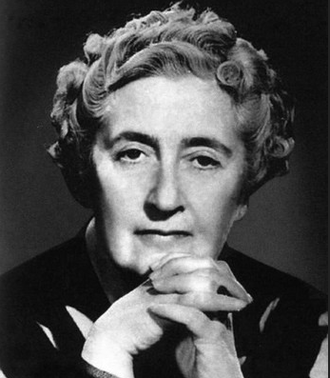
Agatha Christie Biography
Agatha Christie, born Agatha Mary Clarissa Miller on September 15, 1890, in Torquay, Devon, England, is one of the most celebrated and prolific authors in the history of literature. Known as the “Queen of Crime,” Christie authored 66 detective novels, 14 short story collections, and the world’s longest-running play, The Mousetrap.
Christie’s early life was marked by a voracious love for reading and an imaginative mind. She was homeschooled by her mother and later attended finishing school in Paris. Her writing career began during World War I, where she served as a nurse. It was during this time that she wrote her first novel, The Mysterious Affair at Styles, which introduced the world to one of her most famous characters, the Belgian detective Hercule Poirot.
Christie’s works are renowned for their intricate plots, memorable characters, and surprising twists. Apart from Poirot, she created another iconic sleuth, Miss Marple, a shrewd and observant elderly spinster. Some of her most famous novels include Murder on the Orient Express, Death on the Nile, and And Then There Were None, the latter often cited as one of the best-selling books of all time.
In her personal life, Christie experienced both highs and lows. She married Archibald Christie in 1914, but the marriage ended in divorce in 1928 following his infidelity. The same year, she disappeared for 11 days, a mystery that remains unsolved and has sparked much speculation. In 1930, she married archaeologist Sir Max Mallowan, with whom she shared a deep passion for archaeology, often accompanying him on expeditions in the Middle East.
Christie’s literary achievements were recognized with numerous awards. In 1971, she was appointed Dame Commander of the Order of the British Empire (DBE) for her contributions to literature. Her works have been adapted into numerous films, television series, and stage productions, attesting to their enduring popularity.
Agatha Christie passed away on January 12, 1976, in Wallingford, Oxfordshire, England. Her legacy lives on through her timeless stories, beloved characters, and her unparalleled ability to captivate readers with the art of mystery.


 Golden Age of Detective Fiction
Leave a comment