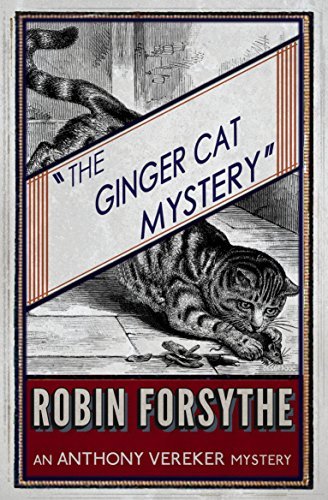
The Ginger Cat Mystery, the fourth installment of the Algernon Vereker series, offers a unique journey into the world of this enigmatic amateur sleuth. This series, faithfully republished by Dean Street Press, is a treasure trove for mystery fiction enthusiasts and fans of amateur sleuth stories. The author, Robin Forsythe, skillfully weaves a narrative that keeps the reader engaged and guessing until the very end. With an informative introduction to the colorful life of its larger-than-life creator, this edition in paperback or Kindle versions is a must-read for all mystery lovers.
Plot Summary
The Ginger Cat Mystery unfolds when the eminent banker and merchant John Connell is found dead; his demise is initially recorded as a natural illness. However, reports to the Home Office suggest a more sinister cause-poisoning. This revelation sets the stage for amateur sleuth Algernon Vereker and Inspector Heather to embark on a thrilling investigation at Connell’s vast estate, Marston Manor, where they interview John Connell’s family. This detailed critique of the plot, characters, and writing style will prepare you for the rich reading experience that awaits.
John Connell, the deceased, leaves behind a complex web of relationships. His young, beautiful wife, Josephine Rivron, was once interested in Connell’s son, Frank, but ended up marrying John and, by all accounts, they had a happy marriage. Frank Connell, despite his father’s death, holds no malice towards him and has had several love affairs, including one with his cousin, Stella. Stella, who lives with her blind father, David Connell, in a small cottage on the estate, is trying to heal from her ill-fated love affair with Frank and quell her father’s suspicions about Josephine. These intricate family dynamics, filled with love, betrayal, and suspicion, add a layer of depth to the mystery.
It’s David Connell who believes that his brother was poisoned and pushes for the exhumation, but John Connell’s body comes back negative for poison. He tries to make amends with John’s widow, with only mild success. An uneasy family truce is in the works, and the family prepares for Frank Connell’s marriage to his fiancé, Valeria Mayo, a dancer, who is staying at Marston Manor with her mother.
As the story unfolds, we see the aftermath of several ill-fated love affairs. Stella, who was once in love with Frank, now avoids him and his best friend, Roland Carstairs. Despite her many refusals to his continuous proposals, she still pines after Frank and Carstairs’s desire to marry Stella. Carstairs, unsure of what to do to win Stella’s love in this unhappy love triangle, attempts joviality, bullying Stella, and displays robust, undying affection and admiration, all of which make Marston Manor a tempestuous place. These personal struggles and unrequited love add a layer of emotional depth to the story.
Another love affair is creating tension at Marston Manor. Rumors swirl that Josephine Rivron, newly widowed, has fallen in love with her husband’s young, handsome doctor, Dr. Redgrave, who openly longs to make Josephine his wife.
The uneasy peace at Marston Manor is shattered when Frank Connell is found dead, shot through the eye, and his body is moved post-mortem. This shocking turn of events reignites the interest of amateur sleuth Algernon Vereker and Inspector Heather, who renew their investigation and delve deeper into the mystery. As they uncover more clues and secrets, the plot takes unexpected twists and turns, leaving the audience eager to follow their journey and discover the truth.
The Review
One crucial aspect to address at the outset of this review is the role of the ginger cat in the story. Contrary to what the title might suggest, there is no ginger cat that plays a significant part in the plot. However, there are ginger cat hairs that are used as a clue to narrow down the suspect pool, a grey cat that occasionally wanders about, and a black cat that provides ornamental filigree. Cats are present in the story, but in the way couches are present in a living room. This is not a cat mystery, and I wish I had known that before reading The Ginger Cat Mystery for #ReadingtheMeow2024 and becoming very aggrieved at the aforementioned lack of cats. So readers, for once, American publishers may have had it right, renaming it Murder at Marston Manor during its initial publication run in the USA.
As a country house murder, it starts with good ingredients: a suspicious death of the family patriarch, his new young wife, has a wandering eye, his young cavalier son, a wake of broken hearts and a shallow greedy fiance, an invalided brother and impoverished daughter all who would financially gain if John Connell went to meet his maker a little earlier than intended.
The general wind of the story, killing off an elderly relative for their money, is well-trod in detective fiction. However, this trope is drastically cut off at the knees when the Home Office investigates the death and John Connell’s death was just the result of an acute illness. Now, the book gets into the meat of the story- a family drama, tinged by ill-fated love affairs, when Frank Connell is found on a stairway in the house, shot in the eye. This method of killing, while seemingly random, holds a significant clue to the identity of the killer, adding a layer of intrigue to the plot.
By the time The Ginger Cat Mystery gets to its true premise-neither a cat mystery nor a killing of a wealthy patriarch-I had lost some of my enthusiasm for the book. As a fan of cat mysteries and the ‘kill-the-patriarch’ trope, I wasn’t sure if we would stay with the killing of the young Romeo theme or if it would be soon eschewed for a new, upstart theme. However, the book solidifies around the death of Frank Connell. Unfortunately, by the time he dies- we know that he is a cad, we know who he’s tossed aside, we know who his new love interest is, and no new information is revealed during the book to alter what we already know of Frank Connell’s character. This lack of character development and predictable plot twists are some of the book’s weaknesses.
Stella Connell is mooning around Marston Manor, jittery, and depressed, she’s been thrown over by Frank Connell and I think most readers can guess why. Maybe her condition shocked readers when it was first published, but it could be more of a twist to modern audiences. There is a rather feeble attempt to shield the murder of Frank Connell, but only one character has the right psychological motive, and Frank Connell has wronged no one else enough to commit the crime. Strangely, Forsythe also adds in the “vital clue” of the ginger cat hairs which could have only been found on two people to whittle down the suspect pool. This neon sign of a clue, which comes too early, is too blatant of a clue.
The mystery of who the killer soon becomes the mystery of busting the alibi of the person sheilding the murderer and trying to figure out how they manged to kill Frank by shooting him in the eye. I feel like this set-up would have been so ingenous in the hands of John Dickson Carr, but Forsythe telegraphs the method of the killing over and over and so clumsily that it really takes no thought on the part of the reader to figure it out.
With motive and method so easily deduced, we are left with a lot of love triangles between almost all terrible people. The characters felt very out of place in a golden age mystery, with the women behaving more like their mothers and grandmothers- much hand wringing and being either waifs or vamps, and the men are brazen bullies or conniving schemers. I found it hard to route for any of them and honestly just wanted the deaths to sort of break up this unhappy circle of souls. I did get my wish- sort of- Stella goes away and dies in the most maudlin and Victorian of ways. The moral is clear: bad girls meet bad ends, which went down better with Forsythe’s original audience.
Algernon Vereker is sort of odd duck to be our protaganist through the story. He feels a little blaise about his work in London. He uses his press credentials to meet Inspector Heather about the Marston Manor case, which is dominating headlines, and then tags along to interview the family for the paper. It feels like this newspaper story pretense is dropped immediatly and Vereker is just straight up interviewing them after informing the family that he is also an amatuer detective. I thought there would be a rigamarole of the family defensively closing ranks against him- but Vereker has effortless personability and a quiet charm which the suspects found disarming. Vereker, is to his credit, a very good listener, he just sort of fades into the background and lets other’s tell them their life story or version of events. With minimal questioning and pushback, Vereker puts suspects at ease and allows them to incriminate themselves by saying too much—a practical and subtle technique.
This means that Vereker sometimes becomes a little colorless and fades into the background. His true personality showing only in his conversations with Inspector Heather- who I feel is badly underwritten in this story- and in lively banter with his friend, and fellow writer, Ricardo. I really loved the opening scene with Ricardo in the begining of the mystery, he;s funny, and doesn’t take himself or his work too seriously. There was alot of meta comentary about writing in their conversations which I also found great. Unfortunately, Ricardo is only occasionally sprinkled in the book after the opening scene. I wonder if he has a more prominent role in other books.
The story and the characters in The Ginger Cat Mystery were disappointing in there simplicity and slightness, but the prose of the story is beautifully written, the attention to color, sounds, setting, clothes, really make The Ginger Cat Mystery a vivid feast for the senses. Robin Forsythe is an exceptional writer, and because of the strength of his prose, I’m interested in reading another of his mysteries- hopefully with less emphasis on romance and more focus on the mystery. The Ginger Cat Mystery is not a bad or poorly written book, it’s just lacking subtilty. It’s entertaining and diverting but ultimately forgettable.

Robin Forsythe Biography
Robin Forsythe, born on February 15, 1879, in Swansea, Wales, was a British author renowned for his detective fiction, particularly the Algernon Vereker series. Before becoming a novelist, Forsythe worked as a clerk in the British Civil Service but faced a legal setback in 1928 when he was convicted of embezzlement, leading to a prison sentence. Following his release, Forsythe published his debut novel, “Missing or Murdered,” in 1929, introducing the amateur sleuth Algernon Vereker. Known for his witty prose and intricate plots, Forsythe continued to write detective stories until his death on September 22, 1937, in London. Although he did not achieve significant commercial success during his lifetime, his work has been reappraised in recent years, contributing to the enduring legacy of early 20th-century British detective fiction.

 Golden Age of Detective Fiction
Leave a comment