
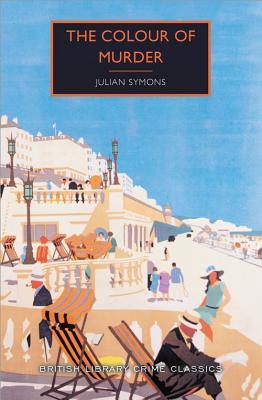
I’m continuing my #20booksofsummer24 challenge hosted by Cathy @746books with The Colour of Murder by Julian Symons. Initially published in 1957, this unique story was reprinted in 2019 as part of The British Library Crime Classics series.
Plot Synopsis:
John Wilkins works in a respectable job and has an unremarkable life until he becomes infatuated with a beautiful librarian named Sheila Morton. Despite being married to his demanding and unsympathetic wife, May, John fantasizes about a life with Sheila.
As John’s obsession with Sheila grows, he invites her to the theatre, saying that he has complimentary tickets when he doesn’t, bullies his way into a tennis foursome and attempts to impress her, and even books a holiday to Brighton at the same time she will be vacationing there with her father.
John has been experiencing blackouts for about a year and finds distinguishing between reality and fantasy difficult. During these blackouts, often brought on by excessive drinking, John frequently flirts with floozies and prostitutes and gets into fights that he can’t remember.
Sheila is found dead on the beach, and John becomes the prime suspect due to his erratic behavior and his desire to be with her. John is arrested, and a case is built against him: Sheila’s recent engagement to another man led to a psychotic break during a blackout, and he strangled her in a fit of rage. John admits to the outage but can remember nothing during the episode and can offer no defense, and the case goes to trial.
The novel explores John’s worsening psychological state and his struggle to differentiate truth from fantasy. The narrative is structured in two parts: the first part is from John’s perspective, revealing his thoughts and feelings to a psychologist who must present his findings at the trial and decide whether John is sane or insane, and the second part covers the courtroom drama as John’s trial unfolds.
As the trial progresses, it becomes clear that the case is more complex than it seems. The defense and prosecution present their arguments, witnesses are called, and the truth about John’s actions and mental state is slowly revealed. The story keeps readers guessing what happened, even with his lawyers, family members, and John, who are unsure of his guilt or innocence.
The Review
Julian Symons’s The Colour of Murder is a classic crime fiction novel. It delivers a compelling mix of psychological depth and courtroom drama that keeps readers on the edge of their seats. The book dives into the complex social pressures in post-war England.
The novel introduces us to John Wilkins, an ineffectual man with a monotonous work life who is ignored and trapped in a loveless marriage with his wife, May. His life turns unexpectedly when he becomes infatuated with an overly friendly librarian, Sheila Morton. Her kindness and inability to be direct when she doesn’t want to do something makes her an easy victim for John to latch onto. This infatuation spirals into obsession, leading John into a tangled web of emotional and psychological turmoil. The story takes a darker turn when Sheila is found murdered, and John becomes the prime suspect.
Symons expertly delves into the psyche of John Wilkins, portraying his internal struggles and descent into obsession. The first-person narrative in the initial part of the book allows readers to experience John’s confusion and fear, making his character incredibly relatable despite his flaws.
The book’s division into two distinct parts—John’s account and the subsequent courtroom drama—adds layers to the storytelling. This structure provides a comprehensive view of the events and heightens the suspense as readers are given pieces of the puzzle from different perspectives.
Symons’ exploration of the facade people present to the world versus their inner world, and John’s inability to integrate these two aspects of the sense of self is fascinating. The man John wants to be is betrayed by the lies he tells. While John is trying to be truthful, he’s also dissatisfied at work and trapped in a marriage to the image-conscious May, who married him because he was supposed to be a man of status. When John tepidly introduces the idea of divorce- under the guise of reading about it, which is a lie- May emphatically tells him that she will never let him go.
The 1950s and its obsession with being a part of the “right set” is vividly brought to life, with Symons’ attention to detail immersing readers in the period, from tennis club mores to drinking at social clubs to May’s desires to host and be seen at the “right” parties. These social rules, which govern social mobility and can lead to better financial standing, are difficult for John to understand and follow. The societal norms and expectations of the time play a significant role in the character’s actions and motivations, adding depth to the narrative.
The book’s second part, which focuses on the trial, is riveting. Symons skillfully portrays the legal proceedings with sharp dialogues and intricate details that capture the intensity of the courtroom. The back-and-forth between the defense and prosecution keeps the reader guessing about John’s fate. After the trial concludes, the drama culminates in a gripping and sad exploration of the character’s fates. John’s guilt or innocence completely recontextualized by the epilogue is incredibly moving, with Symon’s deftly commenting on mental illness and the shortcomings of Britain’s legal system in dealing with people who are not relatively sane or insane and what becomes of them when dealing with the law.
Two questions drive the story: is John Wilkins sane or insane, and did John Wilkins kill Sheila Morton? The story clearly distinguishes between what the law decides- and its shortcomings and the murkier quest for absolute truth on these two points.
The Colour of Murder is a masterful exploration of psychological suspense and crime fiction. Julian Symons’ ability to weave a complex narrative that delves into the human psyche, coupled with a thrilling courtroom drama, makes this book a standout in the genre. It’s a must-read for fans of classic crime fiction and anyone who enjoys a profound, thought-provoking mystery. If you’re looking for a crime novel that goes beyond the typical whodunit and explores the intricacies of the human mind, The Colour of Murder is a perfect choice. Symons’ storytelling prowess ensures that you can put this book down on the very last page.

Julian Symons Biography
Julian Symons (1912-1994) was a distinguished British crime writer, poet, and literary critic, renowned for his contributions to detective fiction and his critical analyses of the genre.
Born in London, Symons developed an early passion for literature and began his career as a poet, publishing his first collection in 1937. He gained acclaim for his detective novels, such as “The Immaterial Murder Case” (1945) and “The Colour of Murder” (1957), which delved into psychological and social themes. In addition to his fiction, Symons wrote historical works and biographies, including a notable biography of Thomas Carlyle. His critical work “Bloody Murder” (1972) is considered an essential study of crime fiction’s history.
Symons was an influential figure in the crime writing community, serving as chairman of the Crime Writers’ Association and receiving numerous awards, including the Mystery Writers of America’s Grand Master Award in 1982 and the Cartier Diamond Dagger in 1990 for lifetime achievement. Married twice, first to Kathleen Manning and later to Jacqueline Palk, Symons passed away in Kent, England, leaving a lasting legacy in the literary world.

#20booksofsummer24 Reviews




 Golden Age of Detective Fiction
Leave a comment