
Today is the penultimate review for my #20booksofsummer reading challenge. It’s been a great summer reading experience, and I am sad to be almost done with it. I’m sure many of you can relate to the bittersweet feeling of finishing a good book or a reading challenge.
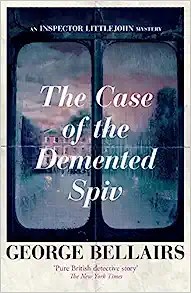
The Case of the Demented Spiv by George Bellairs is the fourteenth mystery in his Chief Inspector Littlejohn series. I am a fan of the compassionate and acerbic Littlejohn and Bellair’s more gritty version of small-town England than many of his contemporaries. The Case of the Demented Spiv was a challenging read, with a unique take on an implausible crime story that kept me engaged even when the story floundered.
The Synopsis
The secretary of a local family-owned textile mill, Ambrose Barrow, is murdered at the mill’s warehouse. His face, done up with grease paint, was found wearing a fake mustache, which puzzled the investigative team headed by Chief Inspector Littlejohn. As Littlejohn digs into Barrow’s life, he is struck by the two very different accountings of Barrow’s life on Earth. Barrow’s Madonna-like widow and his church community paint Ambrose Barrow as a kindly, honest, hardworking man, while his employees say he was a grifter selling inferior goods and pocketing the extra profit. The man suspected of the killing is the “demented spiv” who ardently decries his innocence.
What the heck is a Spiv?
For those of you who don’t know what a spiv is—like me when I started this book—a spiv is an oily person who dresses flashy but is cheap and tacky. This description reminds me of Matilda’s dad, the flashy, cheap, used car salesman played by Danny Devito in the movie Matilda.
The Review
The Case of the Demented Spiv was almost incomprehensible to me as an American reader when I first cracked open the book. There were so many slang terms and social mores that ardently placed the book in a specific period and class structure that is outside of the American experience- which meant I spent a lot of time googling terms and trying to understand a lot of the subtext surrounding what a spiv is and how such a person is viewed in society. It’s not impossible to decode due to context clues, but it has a higher entry barrier than other books in the series for non-British readers.
The Case of the Demented Spiv starts with a mystery that immediately piques your interest- why is Ambrose Barrow dressed in such a ridiculous fashion, and how did someone lure him to the mill while he looked like that? The mystery is further deepened by the wildly differing accounts of Ambrose’s life by his peers, work colleagues, and church family. Littlejohn and the reader are left wondering who is Ambrose Barrow. It’s an exceedingly exciting start that is squandered.
The Case of the Demented Spiv soon widens its scope in the investigation to the people of the small village and the workers at the mill. They are a collection of misanthropic and truly unpleasant characters. Littlejohn soon wishes to be anywhere else, and so does I. We are then treated to a rather plodding investigation where we are led up several garden paths based on lies and misinformation by the characters before Littlejohn is finally given an actual clue.
Misinformation is a mainstay of mystery writing, but because everyone is so unpleasant and the town is depressing, it’s hard to enjoy the long-drawn-out nature of the investigation. The main suspect, the Spiv, is such a shrill, dramatic, and emotionally unstable potential villain that I could hardly stand the first third of the book where he is the main suspect. The Spiv’s oily manner turns out to be an uncomfortable and racist stereotype when the Spiv is revealed to be Jewish and then is referred to as “the Jew” for the remainder of the story, off and on. Bellair’s racist character leaps off the page and leaves a rather unsavory impression on the rest of the story.
Once all of the dead ends are cleared away and we start to zero in on actual potential killers not based on racial stereotypes, the book has some compelling motives, and the way the crime is committed is genuinely clever. It’s a slow burn with a good ending, but there’s a lot at the beginning to wade through before the mystery becomes the story’s central focus, which undercuts the impossible crime that Bellairs sets the stage with at the start of the book.
Bellairs’s unadorned prose lacks Lorac’s beautiful descriptions of time and place and the breezy, conversational way she uses to reveal characters’ motives that keep a character-driven story exciting and intriguing. There’s a natural distaste from the writer and Littlejohn for the victim and his community, and potential has been defrauded. The impossibility and ridiculousness of the crime are reiterated repeatedly but then quickly eschewed for a rather dull and conventional investigation with a succession of ultimately pointless interrogations.
Overall, The Case of the Demented Spiv feels like two books smooshed together, and the second half, which is tightly written and well-clued, suffers from the languishing and stolid pacing of the first half. It’s an okay book, but not my favorite of the series.

20 Books of Summer Reviews
- Whose Body? by Dorothy L. Sayers (1923) | REVIEW
- The Abbey Court Murder by Annie Haynes (1923) | REVIEW
- Speedy Death by Gladys Mitchell (1929) | REVIEW
- Mystery Mile by Margaret Allingham (1930) REVIEW
- The Mystery of the Cape Cod Players by Phoebe Atwood Taylor (1933) | REVIEW
- Jumping Jenny by Anthony Berkeley (1933) REVIEW
- The League of Frightened Men by Rex Stout (1935) REVIEW
- The Sussex Downs Murder by John Bude (1936) REVIEW
- Cards on the Table by Agatha Christie (1936) | REVIEW
- The Case of the Shoplifter’s Shoe by Erle Stanley Gardner (1938) | REVIEW
- Seven Dead by J. Jefferson Farjeon (1939) REVIEW
- The Problem of the Wire Cage by John Dickson Carr (1939) | REVIEW
- The Cat Saw Murder by Rachel Murdock (1939) | REVIEW
- The Norths Meet Murder by Frances and Richard Lockridge (1940) REVIEW
- The Turquoise Shop by Frances Crane (1941) | REVIEW
- The Wrong Way Down by Elizabeth Daly (1946) REVIEW
- The Case of the Demented Spiv by George Bellairs (1949) |
- Nipped in the Bud by Stuart Palmer (1951)
- Vanishing Point by Patricia Wentworth (1953) REVIEW
- The Color of Murder by Julian Symons (1957) | REVIEW
If you’re enjoying my #20booksofsummer24 reviews and want to see who else is participating and what books they are reviewing, check out the master list over @746books. I’d love to hear your thoughts on the books I’ve read so far feel free to share your comments below!


 Golden Age of Detective Fiction
Leave a comment