
I’m nearing the final stretch of my #20BooksOfChristmas challenge, but the abundance of holiday-themed stories is starting to wear me down. To add some excitement, I’m turning to Christmas mysteries from Dean Street Press.
Dean Street Press is known for its Golden Age mysteries, women’s fiction, and books about the golden age of Hollywood. For #DeanStreetDecember, I plan to dive into several of their festive mysteries and aim to finish as many as possible before the month ends.
#DeanStreetDecember

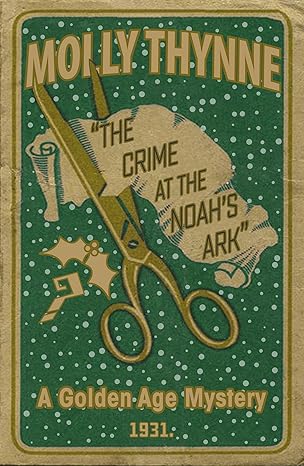


Here’s my reading list:
- The Night of Fear by Moray Dalton
- The Crime at Noah’s Ark by Molly Thynne
- Who Killed Dick Whittington? by E. and M.A. Radford
- The Murders Near Mapleton by Brian Flynn
- Exit Sir John by Brian Flynn
- Dancing Death by Christopher Bush
I’m starting off my #DeanStreetDecember journey with The Night of Fear by Moray Dalton. Let’s see how these mysteries shake up the holiday spirit!
The Story
Just before Christmas, on the 22nd of December, several guests in a large house party scatter throughout the well-appointed manor for a jolly game of hide-and-seek. However, just before the seekers set off in the dark to find their prey, one of the guests, Hugh Darrow, frantically calls for the lights to be switched on. Little did they know, this would be a Christmas they would never forget.
Darrow, with his Pierrot costume covered in blood, says he found another guest, Stallard, a mystery writer stabbed to death, but he didn’t see anyone who could have done it because he was blinded in the First World War.
Local police officer Sergeant Lane officially takes charge of the case. He brings along Scotland Yard Inspector Hugh Collier, who is visiting for the Christmas holiday to help him investigate unofficially. Together, the two men start interviewing the houseguests, and it is revealed that Stallard and Darrow have a long-standing animosity between them, a tension that could have led to the tragic events of the night. Stallard had run off on Darrow’s sister, who then committed suicide, a fact that still haunts Darrow.
However, Darrow isn’t the only suspect, and Sergeant Lane decides to stay in the manor house to keep an eye on things. That night, the gas is left on in Sergeant Lane’s room, a deliberate attempt to kill him. This incident heightens the tension and danger, making it clear that Darrow is not safe in the manor.
Inspector Collier takes up the case, and in reviewing Lane’s evidence, he notices that three pages are missing from his policeman’s notebook. Before Collier can take over the case, his superior, Purley, from Scotland Yard, ousted him.
Purley has a one-track mind to convict Darrow of the crime, so Mrs. Ruth Clare, who is in love with Darrow, hires private inquiry agent Hermann Glide. Glide, known for his unsavory and unscrupulous methods, manages to dig up dirt on two possible crimes that may be connected to the death of Stallard.
This leads to a nail-biting courtroom drama where Darrow’s fate hangs in the balance. With his suave demeanor, Glide manages to unmask the killer before they strike again, adding a thrilling final scene with the murderer.
The Review
The Night of Fear begins with one of my favorite tropes in Golden Age mysteries: houseguests play a game, and under cover of darkness, one of the numbers is killed- usually stabbed with a stiletto ala The Crime at Black Dudley by Margery Allingham or A Man Lay Dead by Ngaio Marsh. However, this party game is just the opening gambit in Moray Dalton’s tour de force detective story.
I soon realized as Collier and Lane are attempting to ferret out where everyone was when the crime was committed that there are a lot of people in the house- like over a dozen players cum suspects with a complex web of friendship, familial relationships, and seething animosities. I privately groaned that the story would be a long slog of a million interviews as we narrowed the pool. However, Dalton neatly sidesteps this by adroitly culling the pool down to a manageable half dozen persons. Expectations are thankfully adverted.
Point to Dalton.
As the investigation unfolds, I anticipated a classic buddy cop story, with Lang playing the Watson to the cleverer Collier. However, Dalton skillfully subverts this expectation by orchestrating Lang’s malicious poisoning, casting doubt on whether it was an accident. This unexpected turn kept me on the edge of my seat, my anticipation constantly thwarted.
Second point to Dalton.
Okay, the book must be about Collier investigating the case and avenging his friend’s poisoning. He is ousted for an actual fool, Purley, due to blatant autocratic politics.
The third expectation was rudely blown up. Another point to Dalton.
I pray that the book doesn’t involve us having to watch Purley smugly bumble his way through an investigation that has been winnowed to the very sympathetic war-wounded Darrow when two very interesting twists happen: first, Darrow isn’t quite as innocent as he has said himself to be, and Purley is parlayed out of the story by shifting the focus to a new investigator-private inquiry agent—Hermann Glide.
I would have learned by now that this story would not be a paint-by-numbers affair and that I should stop trying to anticipate what I’d think would happen. But I didn’t.
Hermann Glide is a little slimeball investigator who feels more at home in an American rough-tumble noir story ala early Perry Mason or any Cornell Woolrich affair, and he digs up a bunch of dirt on Stallard, including deciphering Lane’s missing notes, which he recovered. The notes later prove that Sergeant Lane, one smart policeman, was on the right track before his poisoning.
Glide then crashes a fantastic courtroom scene, which is written with as much showmanship and tension as the most visceral Perry Mason, before confronting the killer head-on.
Dalton’s ability to seamlessly blend hardboiled PIs, compelling courtroom dramas, and traditional detective stories into one book left me in awe. It made me question why I would even bother reading other writers when Dalton can do it all.
The killer is then thwarted and then writes an explanation of how they committed the crimes ala And Then There Were None– the explanation is not 4000 chapters long like in the Christie novel. During this whole climactic trial, I had pieced together a clever potential suspect, motive, and means of the murder, but it turns out that that was the false trail planted by the murderer, and I fell for it, hook, line, and sinker. I didn’t even realize I had been duped until most of the way through, explaining how the crime was committed.
To rub salt into the wound, Dalton then reveals the real motive behind the crime, and it’s so simple and hidden in plain sight that I was stunned and convinced that I never even thought of it—and upon reflection, I would have NEVER thought of it.
I’ve never been so humbled.
Moray Dalton is a master mystery writer, evidenced by her ability to subvert and use mystery tropes to weave a complex and compelling story. I was so enthralled by The Night of Fear that I read it all in one sitting.
Besides a good mystery, Dalton also included two very compelling love stories: one sweet and earnest and the other covert and nearly deadly. My god, is there anything this woman can’t write?
Yes, The Night of Fear is marketed as a Hugh Collier mystery, and he barely figures into the story,y and most of the investigative work is done by Lane and then Glide. I thought Glide would team up with Collier at the end, and the two of them would trap the killer together. Glide, however, was clever and agile enough in the moment to thwart the final murder attempt on his own. However, Fans of Hugh Collier know he plays more of a cameo role in this story. This criticism is negligible in my enjoyment of the story.
That’s the only quibbling little criticism I can find.
Some readers might be frustrated by the presence of several investigators in a portion of the book. I found it intriguing, and it kept me slightly off-kilter, so I could never really settle into autopilot and let any preconceived notions about how a detective story is supposed to supersede what was happening.
The Night of Fear is a complex and compelling mystery written by a master of the mystery genre, who I am surprised fell out of favor with readers since Dalton’s death. I am delighted Dean Street Press has brought Dalton and several mostly women- mystery authors back into print for a modern audience. The Night of Fear, my first Moray Dalton book, truly impressed me and is one of my favorite mysteries of 2024.
#20BooksOfChristmas Reviews

- Murder After Christmas by Rupert Latimer (1944) | REVIEW
- Murder for Christmas by Francis Duncan (1949) | REVIEW
- Groaning Spinney a. k. a. Murder in the Snow by Gladys Mitchell (1950) | REVIEW
- The Adventure of the Christmas Pudding by Agatha Christie (1960) | REVIEW
- The Twelve Deaths of Christmas by Marian Babson (1979) | REVIEW
- Murder on a Mystery Tour by Marian Babson (1985) REVIEW
- Mistletoe Murder by Leslie Meier (1993) | REVIEW
- Death at Wentwater Court by Carola Dunn (1994) | REVIEW
- A Highland Christmas by M. C. Beaton (1999) | REVIEW
- The Christmas Murder Game by Alexandra Benedict (2021) | REVIEW
- The Christmas Appeal by Janice Hallett (2023) | REVIEW
- Hercule Poirot’s Silent Night by Sophie Hannah (2023) REVIEW
- Everyone This Christmas Has A Secret by Benjamin Stevenson (2024) | REVIEW

 Golden Age of Detective Fiction
Leave a comment