
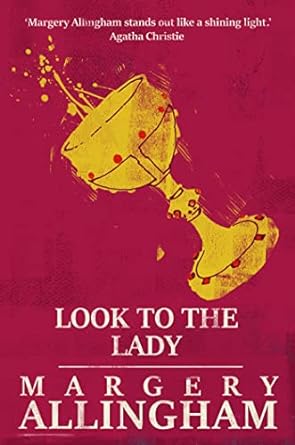
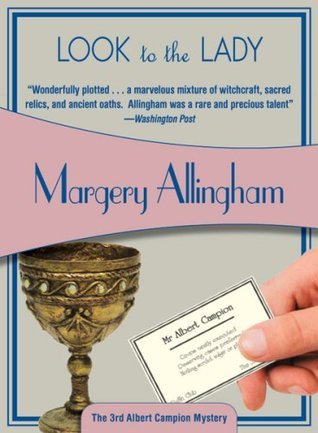
In 1931, Margery Allingham published her third Albert Campion mystery, Look To The Lady, to an awaiting English public. Later that same year, she published it to her American audience under the blander—although more accessible—title The Gyrth Chalice Mystery.
The Story
At its core, look to the Lady is a gripping mystery that revolves around the revered Gyth Chalice, a precious artifact entrusted to the eldest male heir of the Gyrth family for safekeeping. The heir’s initiation into this solemn duty on his twenty-fifth birthday sets the stage for a tale of intrigue and suspense.
The heir presumptive, Percival (Val) Gyrth, is a complex character. Estranged from his family and in dire straits, he is the one chosen to protect the Gyrth Chalice. His journey, guided by the enigmatic Campion, is a fascinating exploration of duty, family, and personal redemption.
Campion, flanked by his roughshod batman, Lugg Morgentsten, hopes that the transfer of power to the new heir will go without a hitch. However, Val Gyrth’s Aunt Di has been acting as the keeper of the chalice in Val’s absence and has been showing off the relic to anyone she meets to stir up her popularity and to use it as a prop in her new-age religious beliefs that the villagers think have set loose a vengeful ghost that haunts the wood.
The stakes are high in Look to the Lady. Lady Di’s indiscretions have drawn the attention of an unnamed art collector, who is determined to steal the Gyrth Chalice. His agents have infiltrated Lady Di’s circle, posing a grave threat to the safety of the relic.
Only a few days before Val takes up his sacred duty- Lady Di is found dead in the wood outside the estate- her face so screwed up in fear it appears she died of fright. Was her horrible death due to some pagan ritual gone awry? Did she set loose an evil spirit in the wood that killed her? Did her indiscretions surrounding the chalice lead to her murder? Is the Gyrth Chalice safe from thieves and killers?
To fend off an international cabal of thieves, Campion stays with Val Gyth as a fellow knight errant to safeguard one of Britain’s most valuable relics and solve what happened to the unfortunate Lady Di.
My Review
Albert Campion, a highborn aristocrat in whose veins run the bluest blood, takes up the mission of safeguarding the Gyrth Chalice and protecting Val Gyrth’s family honor, with the solemnity of a tale akin to Sir Gawain taking on the Green Knight. It’s heavily implied that Campion is born of a family just as noble as the Gyrth’s, as he has been cast out for lowering his position instead- by deigning to work as a spy for Great Britain. Campion’s position, an open secret among his peers, put him in a good position to have access to the highest born and protect English interests by someone they would naturally trust.
Fleshing out Campion’s social position and what led him to his current profession adds much-needed backstory to the character and adds credence- to a theory I’ve advanced in my previous reviews: that Albert Campion’s vagueness and idiocy, which is made much ado about in The Crime at Black Dudley, and Mystery Mile, is an act put upon to both annoy adversaries (and me) as well as underestimate him as an enemy. The dull-eyed act of the previous books is dropped, and a Campion assumes the role of protector knight, taking up his sacred quest.
The book leans into old Saxon rituals and kingly tales as it builds up the ceremony awaiting Val Gyrth- who seems terrified that he will be changed when he goes through the ritual and ramps up Lady Di’s pagan dancing and strange rituals- which give her death a haunted quality.
Only to pull the rug out from under the premise of an otherworldly presence and sacredness surrounding the cup- to the very real and dangerous world of international intrigue. This book has some hazardous criminals, and Allingham goes entirely ham on writing about them. There are dagger fights and climbing up drainpipes, chases, and near misses. This merry intrigue is whether the Gyrth Chalice is safe or has fallen into the wrong hands.
Allingham knows how to write a fun gang of spies and international intrigue. Yes, it’s over the top in The Great Chase way, but it feels dangerous and accurate, and once that part of the book starts- it’s a race to the end.
I like how Allingham spends just the right amount of time building up the mystical backstory of both the chalice and, just when my interest started to wain, to strip away the mysticism and very for a good old cops and robbers chase story full of action and near deaths.
Allingham ties up the mystery of the Gyrth Chalice, its sacred ceremony, anditss hallowed history in a tremendous tongue-in-cheek twist that I won’t ruin here.
Look to the Lady is a delightful, fun read that brings Campion- who verged on caricature in his first novels into greater focus, which I appreciate and even liked in this outing. Campion is held to the fire by his irascible batman, Lugg- who isn’t putting up with any of Campion’s usual antics. Lugg shines as the put-upon, surly servant, and most of the humorous moments come from Lugg chafing against the social pressure of being the dutifulBatmann.
The existential mystery of the sacredness of the Gyrth chalice and its shadowy ceremonies are well drawn-you want to know what the heck is up with this dang cup. Still, I think Allingham was smart to realize that this wasn’t a strong enough mystery to write an entire book about and pivoted to the death of Lady Di.
However, the mystery of Lady Di’s death, which was expertly set up, did not pay off as expected. Campion quickly dispelled the supernatural cause and deduced the reason and probable killer. Her death was swiftly shunted aside to make way for the thrilling thieves’ chase scene. While the Lady Di murder could have been teased out more, the book’s final act delivers a fun, impossible crime in a tower that ramps up the thrills and violence.
While Lady Di’s death proves not to be much of a mystery, Allingham does put in a fun, impossible crime in a tower. This twist ramps up the thrills and violence in the book’s final act, providing a satisfying and unexpected conclusion to the story.
Look to the Lady has three mini mysteries- one for each act, which are plotted well and given a lot of good humor and action that keep Allingham from falling into her usual pitfalls of making Campion an incomprehensible boob for laughs. Campion is a good investigator and resents being shunned by his family for his choices. A little pathos for Campion and handing the humor to Lugg means that Allingham doesn’t have to hang the entire mystery of Campion’s quirky personality but can write well-constructed and intriguing mysteries.
If you’ve read any Albert Campion mysteries and found them particularly difficult because of Campion’s irritating personality. I would give Look to the Lady a go. In that case, it focuses more on the actual mysteries. Look to the Lady might be a good first mystery if you’ve never read Allingham’s work.
Albert Campion Series Reviews



 Golden Age of Detective Fiction
Leave a comment