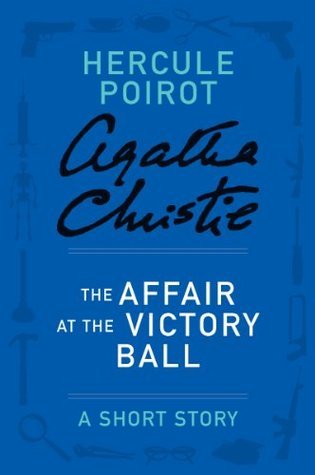
Yesterday, I reviewed “The Queen’s Square“, a short story written by Dorothy L. Sayers, which made several allusions and references to Christie’s short story “The Affair of the Victory Ball” starring her iconic sleuth, Hercule Poirot. I had to post a review to better illustrate the interplay between these two stories.
Publication History
“The Affair at the Victory Ball” is Agatha Christie’s first Hercule Poirot short story and originally appeared in The Sketch magazine in 1923. It was later collected in Poirot’s Early Cases (also published as Hercule Poirot’s Early Cases) and remains notable as one of Poirot’s first appearances in print after The Mysterious Affair at Styles. As Christie was still defining her detective’s voice and method, the story provides an intriguing look at Poirot in his formative narrative years.

Synopsis
The narrative centers on a glittering, highly anticipated Victory Ball—a costume fête in which the guests appear as characters from the commedia dell’arte. During and shortly after the festivities, two shocking deaths occur- young Lord Cronshaw, in full Harlequin dress, is stabbed with a knife, and his fiancée, who left after an argument, is found dead in her apartment of a cocaine overdose. Her death remains a question as to whether it was an accident, a suicide, or a murder related to the murder at the Victory Ball.
These two theatrical circumstances cast suspicion on multiple revelers. The only clues are a green pompom, apparently torn from a Pierrot or Pierrette costume, and six china figurines whose costumes the revelers were made to match a set in Lord Eustace Cronshaw’s collection.
But Poirot had already drawn a chair in front of the mantelpiece and was hopping up upon it like a nimble robin. Above the mirror, on a small shelf to themselves, stood six china figures. Poirot examined them minutely, making a few comments to us as he did so.
“Les voilà! The old Italian Comedy. Three pairs! Harlequin and Columbine, Pierrot and Pierrette—very dainty in white and green—and Punchinello and Pulcinella in mauve and yellow. Very elaborate, the costume of Punchinello—ruffles and frills, a hump, a high hat. Yes, as I thought, very elaborate.
…… “If there are any questions you would like to ask—”
“Only one.” Poirot’s voice was serious. “The costumes—they were reproduced exactly from your figurines?”…… “If there are any questions you would like to ask—”To the smallest detail.”
Hercule Poirot, called in by Inspector Japp, must untangle a sequence of events obscured by disguises, shifting, and a tightly constrained timeline. The case hinges on what truly happened in the hours surrounding the ball, and how appearances—literal and figurative—can mislead.
Review
“The Affair at the Victory Ball” is a quintessential early Christie puzzle that showcases her fascination with theatricality and deception. By setting the drama at a costume ball, Christie gives herself an ideal stage on which to blur identities. The masks, colors, and symbolic roles of the commedia dell’arte characters—Harlequin and Pierrot—become both visual clues and misdirections. Christie uses this framework not merely as decoration but as an integral part of the mystery’s mechanics. The costumes conceal motives and movements; they also allow the killer to manipulate perception in a way that feels almost inevitable once Poirot explains it.
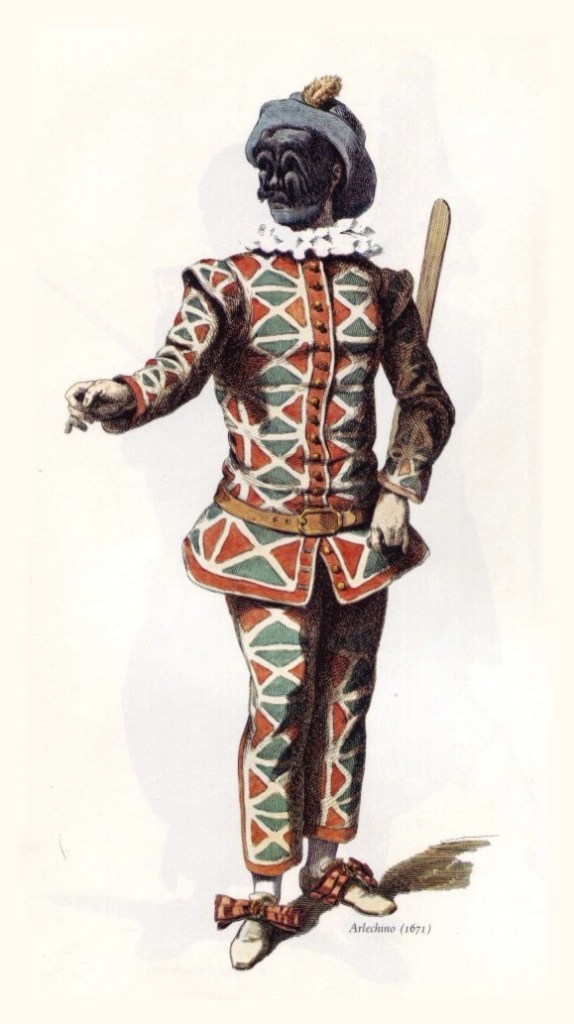
Christie leans heavily into the commedia dell’arte motif to shape character dynamics. The archetypes echo the relationships of the victims and suspects, imbuing the investigation with a thematic resonance that’s richer than many of her early short pieces. The choice of Harlequin in particular—traditionally the nimble trickster—adds a layer of symbolism that Poirot carefully dissects.
However, for most modern readers, a working knowledge of commedia dell’arte theatrical characters and motifs seems a bit remote. I do think English and European readers may have had a better chance of seeing these tropes and characters in action by observing how pantomime and the operas that borrow heavily from this art form are frequently performed and are more a part of the cultural zeitgeist than in other cultures. A certain richness is lost if the reader is unfamiliar with this art form, but not knowing the tropes these characters represent does not detract from watching Poirot solve the crime by reconstructing what really happened the night of the Victory Ball.
As always, Poirot’s strength lies in reconstructing the timeline. Rather than relying primarily on physical clues, he excels at sorting precise sequences: who was seen, when, and by whom; what actions could or could not have happened in a given interval; and how discrepancies in witness testimony quietly reveal the truth. Poirot’s detection method in this story is classic “little grey cells”—logical, orderly, and almost clinical. The reconstruction of events at the Victory Ball becomes the key to cutting through theatrical illusion.
The Verdict
While the story is compact, it still manages to display Christie’s deftness at misdirection. The eventual solution, hinging on costume confusion and emotional rather than elaborate mechanical trickery, feels satisfyingly fair. Some allusions may fly over the heads of some readers, but even without that knowledge, the mystery is entirely solvable and enjoyable for all readers.
Hercule Poirot Novel Reviews
- The Murder of Roger Ackroyd (1926)
- The Mystery of the Blue Train (1928)
- Cards on the Table (1936)
- The ABC Murders (1936)
- Dumb Witness (1937)
- Death on the Nile (1937)
- Hercule Poirot’s Christmas (1938)
- Sad Cypress (1940)
- Evil Under the Sun (1941)
- Cat Among the Pigeons (1959)
- Hallowe’en Party (1969)
- Elephants Can Remember (1972)
Hercule Poirot Short Stories Reviews
- The Double Clue (1923)
- The Disappearance of Mr. Davenheim
- The Adventure of the Italian Nobleman (1933)
- Yellow Iris (1937)
- The Incredible Theft (1947)
- The Nemean Lion (1947)
- The Lernaean Hydra (1947)
- The Arcadian Deer (1947)
- The Erymanthian Boar (1947)
- The Augean Stables (1947)
- The Stymphalian Birds (1947)
- The Cretan Bull (1947)
- The Horses of Diomedes (1947)
- The Girdle of Hippolyta (1947)
- The Flock of Geryon (1947)
- The Apples of Hesperides (1947)
- The Capture of Cerberus (1947)
- The Adventure of the Christmas Pudding (1960)

 Golden Age of Detective Fiction
Leave a comment