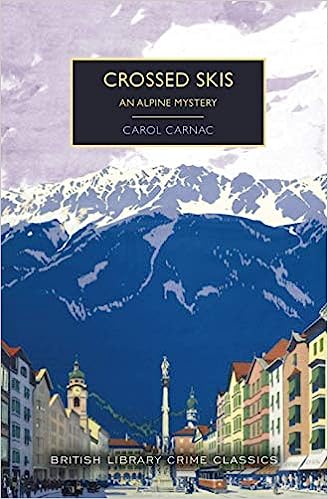
Crossed Skis, written by Carol Carnac, pseudonym of Edith Caroline Rivett, whose E.C.R. Lorac pen name is more well known due to several of her mysteries being reprinted in the British Library Crime Classics series, creates a new detective, Julian Rivers, to helm this Swiss Alps murder mystery.
Crossed Skis employs an unusual narrative device for the time of two having the reader keep track of two parallel stories until they intersect. Story A begins on New Year’s Day, with a frantic Bridget Manners attempting to herd 15 friends and friends of friends Lech am Alberg in Austria for a ski holiday. There are, of course, last-minute dropouts, people coming and going by various routes, and general mayhem in rounding up such a sizeable disparate party of twenty-somethings.
Crossed Skis then switches to story B: The local inspector and early investigators find a body in a boarding house in Bloomsbury that caught fire. Preliminary clues at the scene are scant, except a strange impression in the mud from a ski stick. This mark is totally incongruous with the rest of the stage and clues the reader in that someone in the ski party has assumed the identity of a person in the ski party.
The Review
I enjoyed Crossed Skis immensely, incredibly the slow coming together of the two stories, a narrative device used frequently in modern thrillers. The ski party story rang very accurately as someone like Bridget Manners frantically plans itineraries and makes reservations. The petty squabbles, boisterous nights, and little cliques that form and break apart between the sixteen skiers also rang true to me as someone who has traveled extensively with a 40-person choir around the USA. Friendships are simultaneously deep but tenuous and can be broken apart easily. The losing or stealing of a few pound notes between the group adds suspicion and actually sows seeds of discord between the group believably. Anyone who has traveled with a large group of friends knows something valuable will always get lost.
The missing money was also an excellent way to meet and get to know everyone at the large skiing party- through their reactions, cross-examinations of each other, and gossip. However, sixteen people, while an accurate representation of Rivett’s ski trip on which the book is based from a year before, are too many. I think she wanted to keep the large number to effectively hide the confederate and make it plausible that there would be people on the ski trip unknown to the group planning it. Still, many of them are criminally under developed. In fact, Carnac really only focuses her writing on half that number, so I think she should have just stuck to the smaller number of characters she was interested in developing anyway.
The investigation into the identity of the unidentified man reinforces how easy it used to be to obscure a person’s identity while forensics is still in its nascent stages. Julian Rivers is a pleasant, plodding detective who will only come into his own in Crossed Skis when crossing into Austria and going undercover. Rivers is adept at masking his identity and mission while observing the skiing party and being friendly with them to amass information about the ski party participants. In the latter part of the story, he sheds such close comparison with the plodding, unimaginative Inspector French and becomes a dynamic character.
The dovetailing of the two stories happens much later in the book than I imagined, and I wish the stories crisscrossed each other more to engage the reader, who has a birds-eye view of the situation. This birds-eye view does make the mystery and the synthesis of clues much more accessible, and I don’t think discovering who the killer is will be too taxing for readers. Carnac’s focus is more atmospheric, and she really leans into the setting, with an impending deadly blizzard and everyone swirling suspicions- is the confederate a spy, a smuggler, a thief?- before an explosive climactic chase through the snowy mountains to catch a killer.
Crossed Skis combines a light-hearted winter vacation with a more Crofts-style, dogged detective trying to work out a timeline of events, which kept me from getting too bored with either story, but it may not work for everyone. My interest in Inspector Rivers is piqued, and I hope the British Library Crime Classics series reprints more Carol Carnac stories.
Crossed Skis Reviews
My British Library Crime Classics Reviews
Murder in the Basement by Anthony Berkeley (1934)
The Poisoned Chocolates Case by Anthony Berkeley (1929)
Fell Murder by E.C.R. Lorac (1944)
Murder by Matchlight by E.C.R. Lorac
Post After Post-Mortem by E.C.R Lorac (1936)
These Names Make Clues by E.C.R. Lorac (1937)
Antidote to Venom by Freeman Wills Crofts (1938)
The Hog’s Back Mystery by Freeman Wills Crofts (1933)
Mystery in the Channel by Freeman Wills Crofts (1931)
The Body in the Dumb River by George Bellairs (1961)
The Cornish Coast Murder by John Bude (1935)
Death on the Riviera by John Bude (1952)
Till Death Do Us Part by John Dickson Carr (1944)

 Golden Age of Detective Fiction
Leave a reply to Impact of Evidence by Carol Carnac (1954) | #20BooksofSummer2025 | 3/20 – Golden Age of Detective Fiction Cancel reply