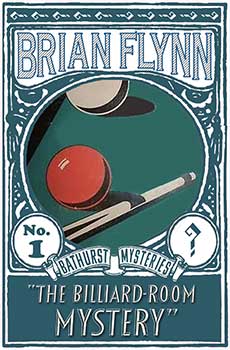
Sir Charles Considine is hosting his annual Cricket Week at his ancestral manor in Sussex, England. What begins as a lively and carefree house party between old friends and new acquaintances is spoiled by murder and theft.
The unlucky murder victim is Gerry Prescott, a friend of Jack Considine, who is known for his genial manner, great skill at cricket, and playing cards. He veritably cleaned the house during a friendly game of cards, taking all of Lieutenant Barker’s ready cash and an I.O.U. from Barker of £208.
Prescott’s body is sprawled across the Billiard table with a Venetian Dagger, a Considine family heirloom plunged into him by the housemaid, Marshall. However, when Inspector Baddeley and his team are called in to investigate the crime, everyone is surprised to hear that Prescott was strangled with a bootlace and his body was stabbed with the dagger after his death. The bootlace, however, is not found on or near the body. Suspicion is immediately cast on Barker after the I.O.U. he had written to Prescott vanished.
The same day that Prescott’s body is found, Lady Considine’s famous “Considine Pearls,” reputed to be of incredible beauty and value, were discovered stolen from her bedroom. Theories swirl amongst the guests about how Prescott must have heard the burglary in progress and tried to intervene, losing his life in the process.
However, theatre actor Anthony Bathurst must be more convinced of the prevailing burglary theory and begins investigating fellow houseguest William (Bill) Cunningham. Anthony Bathurst, whose favorite pet subject is “Modern Detective Fiction” and is practically bursting at the seems to play a “Great Detective” from the mold of Sherlock Holmes. Bill Cunningham narrates most of the book and is delighted to play Bathurst’s steadfast Watson.
Despite many comical allusions to Holmes and Watson and plenty of slapstick comedy of them comparing footprints and spying under beds with magnifying glasses, Bathurst is an incredibly observant, methodical investigator. His excellent visual recall and ability to charm servants, Inspector Baddeley, and even the murderer create an exciting detective. He often plays up the more absurd tropes of detecting, but soon, everyone realizes he is a man with an excellent gift for discovering the tiniest lies.
In his first foray into the detecting arts, Anthony Bathurst must unravel if the two crimes that happened at Considine Manor are related: who stole the “Considine Pearls,” who killed the likable Gerry Prescott, and why?
Book Review
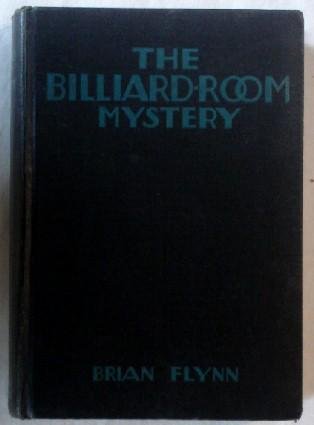
The Billiard Room Mystery is Brian Flynn’s first detective fiction book, and it shows. There’s a lot of heavy borrowing from Sherlock Holmes mysteries and several allusions to fellow crime writers, notably Margery Allingham, whom he names a road after, and Agatha Christie, whom he mentions several times throughout the novel. These nods to fellow crime writers are fun easter eggs and, coupled with the semi-comic tone throughout the book, give the reader a natural feeling of being in on the joke. (However, if your not well versed in detective fiction these allusions do not detract from your reading experience.)
The Billiard Room Mystery also relies heavily on country house tropes, and given Bill Cunningham and Anthony Bathurst’s comedic interplay, it veers at times into parody or pastiche, especially during the beginning of the investigation. A turning point in the narrative comes when Anthony meets Prescott’s mother and the sadness and senselessness of the crime sober him. Remembering the life of the dead was a good use of pathos, which is often glossed over in Golden Age detective fiction, which is usually enamored with the genius of the detective and the high-flying puzzle being solved. I think this is when Bathurst went from playing detective to being determined to solve the crime. It is nice to see the moment that the gravity of a crime becomes real and what drives Bathurst into becoming a real detective. The dissonance between Bathurst’s more severe investigation and Bill Cunningham’s continued light-hearted manner creates a subtle tension between the two, which is also a twist on the sympathetic relationship between “Great Detective and Chronicler.”
Inspector Baddeley is also a well-developed character who shrewdly only tells Bathurst and Cunningham what they need to know. He is adept at recognizing clues, chasing suspects, interrogating and apprehending criminals. He is a capable investigator, and I am curious if he will return with Bathurst in other novels.
A fun atmosphere, setting, and intriguing characters cannot, however, run clunky clueing. The smaller story of recovering Lady Considine’s pearls is dealt with swiftly by (most luck) Anthony Bathurst; frankly, superhuman facial recall is impossible for the reader to solve and only bolsters how Anthony Bathurst would be a great detective. The larger mystery surrounding Prescott’s death is again solved by Bathurst’s great observational powers and the anvil on the head- super apparent clues. It’s one of those books that, through deductive reasoning, the killer can only be one person. The clues that are supposed to throw suspicion on other characters are so superficial that no one in the story seems to believe them, so why should the reader?
The twist ending would have been strengthened if Flynn had been more subtle in his plotting. However, given that there are about 50 in the series, this flaw will improve quickly. Overall, it’s a fun interwar country house romp that doesn’t blow anything out of the water and is a little evident in plotting and uneven in obscuring clues. Still, I enjoyed The Billiard Room Mystery and am interested in reading more of the Anthony Bathurst series.

 Golden Age of Detective Fiction
Leave a reply to My January 2024 Book Haul – Golden Age of Detective Fiction Cancel reply