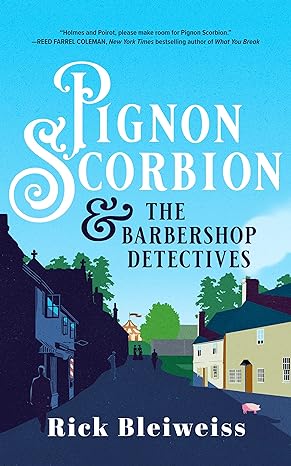
In 1910, Pignon Scorbion was installed as the new Chief of Police in the sleepy backwater of Haxford. Scorbion, a fussy, erudite man, soon bowls over the yokels with his strange habits, mysterious past, and exacting nature. In an attempt to better acquaint himself with local gossip, he goes weekly to the barber shop, which is owned by a long-time friend, Calvin; there, he meets several men who are delighted to offer their insight in helping him solve cases while raptly enjoying tales of Scorbion’s colorful past. His most devoted listener is an aspiring young newspaper columnist who writes and loves writing about the new police chief and his adventures.
However, Haxford is soon embroiled in a mystery as to whether Jonathan Betine is the illegitimate son of one of Haxford’s most prominent citizens and heir to the Gromley fortune. Betine contends that his father, a traveling silk salesman, seduced his mother after her cabaret and promised to return but never did. He only has her version of the story and an old business card as proof of his claim. However, the man in question denies that he is Betine’s father, although he admits to visiting the town Betine is from and that the business card is one of his.
Scorbion must sift through decades-old memories, letters, facts, and fiction to discover the truth behind Jonathan Bentine’s past. Helping him with his investigation are his trusty barbershop friends who work as a sort of Greek Chorus and conduct interviews and hear evidence. After hearing all of the sides of the story, Scorbion quickly unravels the case by paying close attention to the various timelines.
With the reader and the town now used to the methods of Pignon Scorbion, his attention to detail and cerebral prowess are challenged by a spate of seemingly senseless crimes: Dr. Frank Morgan’s American Tomahawk, which adorned his mantle is stolen, a prize-winning pig is kidnapped, and a farmer is brutally murdered. Scorbion must uncover what links these seemingly random acts of violence and root out what is rotten in Haxford.
The Review
Pignon Scorbion & the Barbershop Detectives was an absolute slog for me. I liked the plot of the book. The crimes were fun, if a little easy to solve at first; I also wanted the author’s choice to cross-examine memories and past actions throughout the book. It was great for the book to admit and even lean into the fallible nature of memories and how they can create a false sense of narrative or even identity. The story we tell ourselves is not always the truth, and Scorbion, trying to heal from his broken past, knows this truth.
The rest of the book could be better. I hated the verbose and persnickety narration that painstakingly takes pages to set up every scene. It was like reading a play with all the stage directions about how each chair is positioned and where every character is standing as necessary narration. This penchant for over-explantation bogs down the flow of the story and makes each scene feel like a scene instead of what naturally would happen due to previous events.
A lot of this over-explanation and obsessive attention to detail is a mistaken attempt by the author to drive home what Pignon Scorbion is like. He’s like Sherlock Holmes and Poirot, but better, even more brilliant, and good at deduction! Combining that, a Freeman Wills Crofts level of attention to timetables means it’s cumbersome on exposition.
The only thing worse than the dialogue is the stilted wooden dialogue. Pignon Scorbion is educated and unique, so every sentence needs to sound like he’s swallowed a thesaurus. Scorbion, was especially impressive to the ordinary Haxford citizen, but it seemed so forced and over the top to me.
Pignon Scorbion’s deductive powers are good, but the mysteries created by Bliewess were so evident and hackneyed. Telling me that the character is brilliant at deduction means much less than showing how he unraveled a crime. His method of having his friends sit and adjudicate the facts and merits of each crime brought before him turned me off. His cronies are not lawmen or even in the legal profession; they are barbers. The author may have wanted some Socratic methodology applied to the case, but that makes each discovery take forever. If Pignon Scorbion is genuinely interested in using the Socratic method, he will gather a new group of people to review the case each time.
Ugh, so much time is wasted presenting each idea to them to decide that Scorbion was right. The author attempts to humanize Scorbion by giving an extended flashback where we, the audience, learn the meaning of Scorbion’s ridiculous name. (I hope you’re excited to learn how Scorbion is conceived because you’ll find out!) After constructing a tortuous backstory spanning three continents, the author seems to realize that a name does not give a person a personality and then decides that a previous love affair also wounds Scorbion. Now grafted onto the story is a flaccid love story with the new woman in town who is just as an insufferable “pick me” person as Scorbion.
I almost did not finish this book. I was so frustrated because many of the long descriptive passages set in the memory of the characters were so rich and well-written that I was affronted every time we had to go back to the clunky, mechanical mystery and verbose narration. I won’t be back to Haxford for Scorbion’s next adventure.


 Golden Age of Detective Fiction
Leave a reply to January Reading Wrap-Up 2024 – Golden Age of Detective Fiction Cancel reply