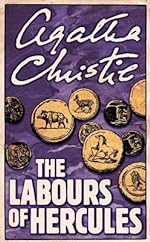
The Labors of Hercules is a collection of twelve short stories starring Hercule Poirot. Hercule Poirot is entertaining an old friend who is interested in the classics. Together, the friends discuss Greek mythology, and it soon becomes apparent that while Hercule Poirot (and his brother Achilles) are named after Greek heroes, he is woefully ignorant about his namesake and Greek mythology. After his friend leaves, he reads Greek mythology for three days. Like his namesake Hercules, he decides to take on twelve cases of labor before retiring and moving to the countryside to grow better-tasting vegetable marrows.
The Arcadian Deer
Hercule Poirot’s car breaks down, and walks a mile and a half through the snow to the Black Swan, where he takes a room for the night. The local mechanic visits Hercule Poirot in his room and Hercule Poirot is taken aback at how handsome and courteous the young man, Ted Williamson, is. Shyly, the young man asks Hercule Poirot to find a missing young lady, a visiting ladies’ maid at the local hall. Ted Williamson met her when a car broke down in the hall, and he went up there to fix it. They talked for a while and went on a date where they walked around. They made plans for a second date, but she never showed. When he went to the hall to talk to her, Ted was told that Nita was fired. Ted Williamson wrote to Nita’s address, but her letter said she no longer lived there. Worried and upset, Ted asks Hercule Poirot to find her because he suspects she is pregnant or in trouble.
Hercule Poirot goes to Nita’s last known address and bribes the landlady for information. The landlady believes Nita returned to Italy after being fired by her employer, a Russian dancer. Hercule Poirot tracks down the dancer’s old troupe and learns that she was a favorite of George Sanderfield, owner of the hall.
Hercule Poirot interviews Sir George Sanderfield about the Russian dancer but says he is no longer in touch with her. When Sir George Sanderfield is pressed about her maid, he only remembers her current maid, Marie, a thief and a liar. Marie tells Hercule Poirot that the previous maid left hurriedly and that her mistress was temperamental and strange.
Hercule Poirot talks to friends who know people in the art world and says that the Russian dancer, Katrina, has traveled to Switzerland to a sanitarium to die of what is heavily alluded to be tuberculosis. The maid went back to Pisa, Italy. Hercule Poirot travels to Pisa and interviews the maid’s family and discovers that she died of appendicitis. He visits the young maid’s grave and is troubled that everything is too neat.
He travels to Switzerland to see the dying dancer, Katrina and she tells him that Nita died. He presses Katrina on why her family calls Bianca and not Nita. Katrina says she does not know why the maid changed her name, but Hercule Poirot does not believe her. He says that Katrina pretended to be a maid named Nita and went on a date with the handsome garage man. When her illness became too apparent, she went away and waited to die, feeling like she could not give up her life on the stage and marry a lowly garage man. Hercule Poirot lightly chides Katrina, saying that she could get better if she wanted to marry a garage man, and their children would be handsome and fantastic dancers.

The Review
Honestly this is the first short story in The Labors of Hercules collection that didn’t work for me. The whole story is a collection of interviews with no connective tissue, scenery, or atmosphere. Christie makes an attempt to tug on the heartstrings of the reader with her handsome lovestruck protaganist and his ill fated love with a beautful dancer, but it never comes together. In fact despite painting Ted Williams as a golden hearted god, Christie doesn’t bother bringing him into the conclusion, leaving it up to the reader to imagine that Katrina somehow recovers from tuberculosis and reunites with Ted and they marry and live happily every after. Which if you know anything about tuberculosis, is….a fantasy,
Despite lots of interesting locales such as snownound Switzerland and a magestic graveyard in Pisa, a sanitorium on the sea, we spend mere moments soaking in the whirlwind journey that Hercule Poirot is before we are whisked away to boring interrogation after boring interrogation. There’s no great intrigue or lies to uncover- most of the characters can barely remember each other so there’s very little thay can bebothered to hide from Hercule Poirot. In contrast with the interrogations and subterfuges recounted in the previous story The Lernaean Hydra, this reads more like an outline that Christie forgot to flesh out before handing it in to her publishers.
This story is really feeling the constraint of the twelve labors of Hercules theme and has only a few ham fisted references that confuse rather than amuse the reader.
The Labors of Hercules by Agatha Christie
Story #1 The Nemean Lion
Story #2 The Lernaean Hydra


 Golden Age of Detective Fiction
Leave a reply to The Labors of Hercules: The Apples of Hesperides by Agatha Christie (1947) – Golden Age of Detective Fiction Cancel reply