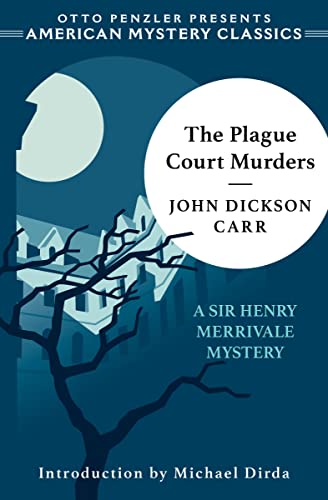
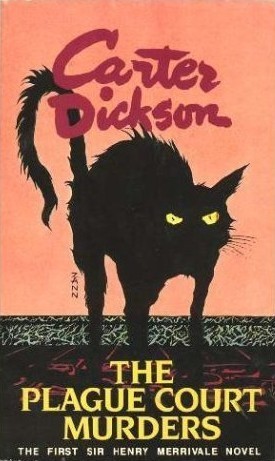
In 1934, Carter Dickson introduced the world to his newest creation, Sir Henry Merrivale. He is a garrulous old spymaster, modeled after Mycroft Holmes, who begins his foray into detection with a creepy tale of ghosts and murder in The Plague Court Murders. To follow is an illustrious and career-defining twenty-two-book series that would reconceptualize the locked-room subgenre of the detective story. The Plague Court Murders is faithfully reprinted by American Mystery Classics and introduced by Michael Dirda in 2021, and I highly recommend that version.

The Plague Court Murders
One rainy September evening, while sitting around the fire at their gentlemen’s club, Dean Halliday invites Kenneth Blake to spend the night in his family house to see if it’s haunted. Halliday’s aunt, Lady Benning, and his fiance, Marion Latimer, frequently visit medium Roger Darworth, believing the family house hosts supernatural phenomena. Halliday, unsure what to think, asks Blake to accompany him to Plague Court to watch for spirits. Blake agrees, provided he can bring along a friend, Detective Inspector Masters, whose pet hobby is busting bogus spiritualists.
That same day, a dagger donated to the British Museum by Halliday’s family as a supposed relic of common hangman Louis Playge, who used to own Plague Court, is stolen by a tall, lean man with a bad neck. Halliday believes the dagger is going to be used in some ritual to bring an evil spirit to this plane so it can take possession of his body.
Halliday tells Blake and Masters on the car ride from his apartment to Plague Court that he has seen a strange face. When they arrive at Plague Court, they are met by Lady Benning, Marion, a spiritualist, Roger Darworth, and his assistant, Joseph, Marion’s young brother, Ted Latimer, and Major Featherton are all at the house, ready to perform an exorcism so James can rest in peace.
A week before, the same group gathered and had a session of automatic writing because they believed the evil spirits took hold of Halliday’s older brother, James, and made him commit suicide. However, Darworth pretends that the spirits tell him nothing and burns the paper on which he recorded messages- not before others see “only seven more days are allowed” scrawled on it.
Halliday, Blake, and Masters wander the house and discover many boobytraps laid to scare and harm Halliday. While they are reconnoitering, they are joined by Detective Sergeant McDonnell, who is watching the house and searching for the missing dagger.
Detective Sergeant McDonnell has been tailing Darworth for months and is closely watching the small room where he’s padlocked himself on Plague Court grounds. McDonnell is convinced someone will try to break into Darworth’s sanctum. That night, Dartworth is brutally murdered, slashed to death with Louis Playge’s dagger, and left in a pool of blood. Masters saw nobody enter the padlocked room, and no footsteps in the mud surrounded the building. Baffled, Masters, Blake, and McDonnell work together to solve this impossible crime.
While interviewing Featherton, he admits that on the paper Darworth burned, there was another line stating something about someone named “Elsie Fenwick,” who McDonnell reveals was Darworth’s much older first wife who, a year after their marriage, almost died due to arsenic poisoning. The doctor and the police suspected Darworth, but Elsie’s maid swore that the old woman took the poison herself. Elsie doesn’t press charges, and all is forgotten until several years later when Darworth goes to a precinct and says that his wife is missing. He supplies the police with doctors’ letters explaining she was depressed, and when she disappeared during a shopping trip, it was because she took her own life. The police are not entirely convinced and have been watching Darworth ever since. Darworth marries again, but it proves to be a rocky match. The second wealthy wife spends her time on the Riviera and outfits Darworth with money as needed.
Masters investigates Darworth’s mysterious death for a while without success. The sensational case is run in the newspapers daily, and the suspects are hounded mercilessly. Disgruntled, Major Featherton meets with Blake to see if he will contact his old mentor, Sir Henry Merrivale (H.M.), to take up the case. Blake agrees to arrange a meeting, and when they get to Merrivale’s door, they find Masters already there to ask him for help in solving the mystery so he can keep his job. Masters recently discovered that Darworth’s second wife is Glenda Watson, maid to his first wife. She inherits an estate of 250 thousand pounds upon his death.
Merrivale, as wise and lazy as Mycroft Holmes, expounds his theory of the crime: the locked room element was set up with a confederate at the seance party. Initially, Darworth was just using Lady Benning’s grief to get some money out of her, but he soon fell in love with Marion Latimer, so he used the Louis Playge ghost story to stage a seance and impress her with his powers. Since Marion Latimer was already under his psychological spell, he hoped this display would make her fall in love with him, too, and they would marry. However, his confederate killed Darworth.
Darworth killed a cat, drained its blood into a jar, and splashed it around the room he was locked in; he threw the bottle in the fire, hoping it would be destroyed. In his excitement, he tripped in the blood and smashed his glasses. Darworth proceeded to superficially stab himself several times in the arms and legs with Louis Playge’s awl, which Merrivale astutely comments cannot cut, just stab. His confederate stabbed him several times in the shoulder with the Louis Playge knife and a few other places as planned before delivering the deadly blow with another knife. In Darworth’s body, there was only one deep cut that would have been fatal that couldn’t have been made by the Louis Playge awl. To prove his theory, Merrivale has Darworth’s back examined, and the medical report comes back saying that the section where the superficial wounds are has been numbed with Lidocaine.
Merrivale explains he suspects Ted Latimer as Darworth’s accomplice since he was the person with the key to the padlock and has now gone underground, hiding from the police. Merrivale instructs Masters to search Darworth’s house again for more evidence to tie Ted Latimer to the crime and Darworth’s meticulous planning of the faked seance.
Masters recounts his previous visit to Darworth’s house with Darworth’s lawyer, Stiller, to Merrivale. The house, staffed by a butler, was an occult museum, with various rooms used for spiritualist matters and only a few rooms for Darworth to live in. One of the workrooms was wired entirely to make different recordings, allowing Darworth to control the seance. The house, devoid of any papers, led Masters to believe that important documents were kept elsewhere. Inside the house, they also find Lady Benning. Although the butler swears he never let her in, she considers coming to Darworth’s house facilitates her ability to talk to her dead nephew, James, and claims that Ted Latimer or her other nephew, Dean, are involved with the murder before getting in a taxi.
Earlier, Masters called Marion Latimer to see if she knew where Ted was, but she explained that he had gone to bed before her and had arisen before she woke, leaving a note that he was “investigating” the crime. Thus, this solidifies a stronger case against Ted in Merrivale’s mind. Still, Masters is not convinced and suspects Dean Halliday of being the confederate due to Halliday’s leering overconfidence in his innocence. Masters and Merrivale argue provisions against each suspect, but no satisfactory motive for the crime currently satisfies them. Further investigation by McDonnell reveals that one of Latimer’s maids heard a screechy, high-pitched voice talking to Latimer before he left with a rucksack. The voice said, “You never knew, did you?” before departing. A man saying he was Ted Latimer called Marion at home and intimated that he was going to Scotland, but Marion was unsure of the voice, and McDonnell could not get a suitable identification at Euston Station. McDonnell suspects that Latimer will visit his mother in Scotland and sends a telegram for him to return.
Masters, Blake, and Merrivale, search for Darworth’s workshop together and call Marion Latimer to meet them there. She readily agrees because someone has been making threatening phone calls to her and Ted’s home. At Darworth’s, they find a painted replica of James Halliday’s face half-finished. They also reunited with Marion Latimer, who had a telegram from her mother saying that Ted was not with her and that she would not return him even if he were. During their time at Darworth’s workshop, Merrivale receives a phone call and hurriedly gets a ride from Marion Latimer, who makes an appointment with her and Halliday the following day. When Masters presses Marrivale about his strange behavior, Merrivale announces to Masters and Blake that Joseph, Darworth’s addict assistant, has been murdered.
Joseph had been stabbed with the stolen Louis Playge knife, bound, soaked in kerosene, and burned alive in the cellar furnace. With the second murder stemming from the strange night at Plague Court, Masters, Blake, and Merrivale are in a race against time to unearth the twisted motive for these gruesome crimes before the murderer escapes justice.
The Review
The first third of The Plague Court Murders is heavily dressed in gothic overtones, family curses, and macabre imagery straight out of The Fall of the House of Usher. The decaying, swirling supernatural atmosphere is creepy and oppressive. However, this is stripped away after the death of Darworth, when Masters pointedly asks the assembly if they believe that a supernatural entity killed Darworth, to which most of them admit that they do not. A veil is lifted, and now, the reader is encouraged to focus on solving an impossible crime.
John Dickson Carr’s use of letters, recorded interviews, and newspaper articles provided a lot of texture and nuance about the characters and their impressions of one another. It also was a unique way to break up extended expository interviews or backstories so that the reader discovers information instead of merely being told information. The letters also added heavy mythology to The Plague Court Murders, which sucked me into this deliciously depraved world that encompassed Lady Benning’s every thought. Like several people before her, it became easier to understand how the unbelievable story of Louis Plagye spawned generational fear that Darworth harnessed for his gain. Despite not being taken myself, I had a moment of grief when Masters pricks the illusion with his assertion that this whole affair is about one person cruelly, with malice aforethought, killing another.
Masters proves to be an extraordinarily clever and thorough policeman. He investigates several avenues that the murder could have been committed and works in tandem with Blake and marshalls Detective Sergeant McDonnell effectively. Unlike many police officers in detective fiction, Masters is a capable and astute crime solver. In most cases, he would never need Merrivale’s help, unlike the bumbling police officers who populate most crime fiction. Masters is also exceedingly competent at investigating suspects, digging through their past, and tailing them in the present. Much of the dogged policework is done by him, although John Dickson Carr does not dally over the machinations of policework; instead, Masters’s quick and competent results are his focus. The immediate results seem a bit far-fetched, but they fit better with the fast horsepower of the story. The Murders at Plague Court makes good use of police officers and eschews the idea of making the story a police procedural, which would grind John Dickson Carr’s natural, fast-paced writing to a halt.
Merrivale’s explanation of the method of the first crime to Masters, Featherton, and Blake tallied with my lines of thinking that the Louis Playge story and seance were just window dressing to divert attention away from Darworth’s true aim. I suspected Darworth had a design on Marion Latimer, but there was no proof. I think more groundwork needed to be laid on the motivation for why he wanted his second wife, establishing a pattern on why he would like a third wife. Also, while John Dickson Carr may have cut Darworth from similar cloth as Rasputin, a svengali who could easily manipulate women through hypnosis or psychological manipulation disguised as mysticism, the reader was never shown Darworth using these tactics on Marion and why she was especially susceptible to them, making her vulnerable to marrying Darworth.
However, I was caught off guard by the grisly murder of Joseph, and while things were becoming clearer for Merrivale, I was in the dark.

I also found it interesting that John Dickson Carr has Merrivale call out the absurdity of locked room crimes as so fantastical that they technically could happen the way authors describe them. Still, no real murderer would ever use such a contrivance. The locked room element works well in this particular case and story because the whole setup is a performance by Darworth; he is obsessed with hocus pocus, and the elaborate window dressing was just taken advantage of by a calculated killer. I found it refreshing. I like locked room puzzles because I find them exciting logic puzzles to work out, but sometimes they let down a good mystery because they seem so absurd and contrived. It is a thing that exists only in detective fiction, not in real-life murders, and the author has to carefully thread the needle between a cleverly disguised impossible seeming crime and constructing a way for the crime to happen that is too outlandish to be entertaining enough to defy any disbelief. The explanation of the locked room can genuinely make or break a mystery.
What impresses me about The Plague Court Murder is John Dickson Carr’s deep knowledge about what makes a good mystery and keeps readers reading mysteries. There’s a lot of dialogue between the characters. John Dickson Carr details how some aspects of this story could only happen because of the characters’ nature and the criminals’ particular motivations. He often has asides in the story where the characters discuss detective fiction and how it heightens or flat-out ignores certain realities of actual crimes for the sake of a good story- which is John Dickson Carr’s whole thesis for this book; he set out to write a good mystery and his attention is on making the story work, with every setup, there’s a payoff, there’s an intelligent policeman because who wants to read a mystery where the detective can’t find his nightstick, there’s a larger than life, amateur that solves the case, whose domineering personality is used sparingly as not to spoil the effect of all the stage work by Darworth and investigating prowess of Masters. Merrivale doesn’t even come into the story until about 60% of the way through The Plague Court Murders- he’s sort of the gilding on the lily.
I’m also impressed by John Dickson Carr’s labyrinthine writing style. He has a unique habit of stating a fact, plot point, or character trait in a conversation, rushing on for another page or two, and having his characters meet with other characters, expounding on the earlier point and adding new information. It adds much texture and richness to the story, throwing the reader slightly off balance. Initially, it’s hard to know what is essential to the story, but the constant circling back underlies what John Dickson Carr wants the reader to focus on organically. It’s also an ingenious way to constantly have many small payoffs to tiny details and threads that are usually forgotten or glossed over. This writing style shows a depth of craftsmanship not traditionally found in the detective novel. However, his writing style can be challenging and overwhelming for new John Dickson Carr readers. The Plague Court Murders, like his other works, is a book that requires you to actively read and participate in solving in a way other authors don’t demand of their audience; even with his overall emphasis on producing an entertaining mystery, don’t expect a light, fluffy read.
Merrivale recreates the murder of Darworth at Plague Court with a stuffed dummy and apprehends the murderer with a flourish, bringing in the element of the fantastic and theatrical for one last performance. Despite reading the book carefully and taking extensive notes, which picked out many of the vital clues, I still would have never worked out the solution, which, upon Merrivale’s explanation, was deftly plotted and clued for the reader. It’s maddening how good this book is! The Plague Court Murders is a rare book that you could read for the first time over and over again. John Dickson Carr pulled off a magic trick and even told me how it was being done, and I was still surprised, which is, I think, what makes him a timeless grandmaster of detective fiction.
My John Dickson Carr/ Carter Dickson Book Reviews
And So To Murder by Carter Dickson – Sir Henry Merrivale #10

Till Death Do Us Part by John Dickson Carr – Dr. Gideon Fell #15


 Golden Age of Detective Fiction
Leave a reply to TV Series Review: Colonel March of Scotland Yard (1954-1956) – Golden Age of Detective Fiction Cancel reply