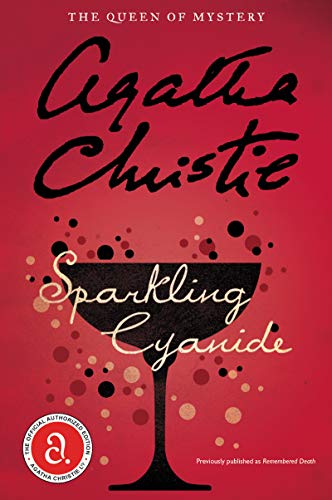
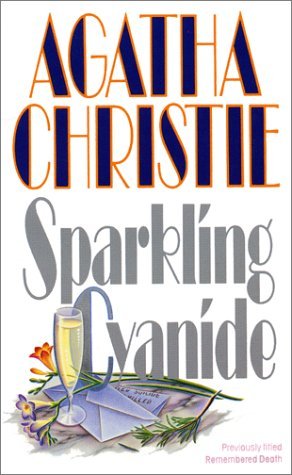
Sparkling Cyanide, penned by British author Agatha Christie, debuted in the US through Dodd, Mead, and Company in February 1945, titled Remembered Death, and hit UK shelves in December of the same year under Christie’s original title, published by the Collins Crime Club.
Colonel Race makes his fourth and final appearance in Sparkling Cyanide, delving into the enigmatic deaths of a married couple, occurring precisely one year apart. The narrative of this novel expands upon the storyline introduced in the short story “Yellow Iris.”
Synopsis:
A year before the current events unfolding in Sparkling Cyanide, a fateful dinner unfolded at the swanky Luxembourg restaurant. George had arranged a birthday celebration at Luxembourg in hopes of helping his wife, Rosemary Barton, get into better spirits after having influenza and falling into a post-illness depression.
The Barton were joined for dinner by Iris, Rosemary’s sister; Anthony Browne, Rosemary’s friend with a shady past; Ruth Lessing, George’s deadly efficient secretary; and Stephen and Sandra Farraday. All of whom had a reason to wish Rosemary dead. After dancing and gaiety, George proposes a toast to Rosemary. She takes a sip of champagne and dies horribly at the table. The police rule out Rosemary’s death as a suicide, but rumors and suspicions fester around the other guests.
Stephen Farraday, a high-ranking government official, had an affair with Rosemary but had recently broken everything off, Feeling that Rosemary was too mentally unstable to keep the affair discrete. His wife, Sandra, knew of the affair and wanted to move back to London before someone would use the illicit affair to harm he husband’s political prospects and disgrace her incredibly well-to-do family. She did not want a scandal, especially if that scandal would require her to divorce Stephen to save face.
George Barton recently stumbled upon some love letters Rosemary had written to a loverbut was unsure whether the lover was Stephen Farrady or her new friend Anthony Browne, who he suspected of having a criminal past. George Barton’s suspicions of Anthony Brown were not unfounded; Browne knew some rather unsavory things about Rosemary, and his connection to Rosemary appears sinister.
Rosemary Barton was beset on all sides, especially by Ruth Lessing, George Barton’s excellent, calculating secretary, who envied her wealth and position and coveted Rosemary’s death to become the second Mrs. Barton.
Rosemary’s only ally is her much younger sister, Iris, but Iris discovers upon Rosemary’s death that she is her sole heir and bears the brunt of much gossip and police suspicion in her sisters bizarre death.
Following Rosemary’s passing, her aunt Lucilla Drake moved in with George and Iris. Loyalty to her son, Victor, drove Lucilla to financially support him. Anthony returned to town, forming a bond with Iris.
George’s investigation into Rosemary’s alleged murder led to a daring plan: a repeat dinner with the original guests plus an actress resembling Rosemary where he will unmask the murderer. George also invites Colonel Race an ex army colonel turned detective and old friend to be present for the dinner, Colonel Race is prevented at the last moment from attending this macabre dinner and tries to warn George Barton not to go through with it. However, George Barton has worked himself into a fever pitch and he gathers everyone together to “toast Rosemary” on the one year anniversary of her death. Before he can unveil the murderer he is poisoned in the same manner as his late wife.
Upon hearing the death of George Barton, Colonel Race decides to take up his friends investigation and catch the killer. Police suspicion falls on Stephen, but Colonel Race suspected Anthony, believing him to be after Iris’s inheritance. Yet, Anthony revealed his true identity as a government agent. and all the noose begins to tighten around Iris, in whose handbag the poison was found. However the more Colonel Race investigates the more convinced her becomes that Iris not George was the true target of the poisoning.
The Review
Sparkling Cyanide, the fourth installment in Agatha Christie’s Colonel Race series, was published in 1944. Despite being one of Christie’s more frequently adapted works for television and film, it distinguishes itself by not featuring her iconic sleuths, Miss Marple or Hercule Poirot. Instead, readers follow the relatively subdued Colonel Race, who only emerges prominently in the latter part of the narrative.
The plot revolves around the death of Rosemary, initially believed to be a suicide, prompting suspicions from her husband regarding foul play. As he delves deeper, uncovering Rosemary’s extramarital affair through cryptic notes, the question of who among the dinner guests on the fatal evening is responsible looms large. Could it be one of the men present, or perhaps her sister, his secretary, or even one of the spouses?
Divided into three parts, the narrative provides insights into each character’s perspective, culminating in a dramatic reenactment of the dinner where another death occurs. The central mystery keeps readers engaged, but ultimately, the resolution hinges heavily on deceit rather than deductive brilliance.
The novel’s structure is commendable, offering readers a glimpse into each character’s background and motivations. Despite minimal direct interaction with Rosemary, her relatives’ portrayal provides ample suspects with potential motives. While initially overwhelming due to the abundance of characters, the dynamics between them gradually become clearer, enhancing the narrative’s intrigue.
However, the mystery itself falls short of Christie’s usual complexity standards. While the resolution is plausible, it relies heavily on manipulation and misdirection, and the scheme is clever, if not wholly believable. Its success depends upon a lot of luck. While Christie’s adeptness at crafting twists and turns is evident, the story’s reliance on contrivance rather than genuine deduction undermines its impact.
Despite its flaws, Sparkling Cyanide remains a worthwhile read, primarily due to Christie’s engaging prose, unique story structure, and the intricate interpersonal dynamics she explores. While it may not rank among her most memorable works, fans of classic whodunits will still enjoy its clever narrative and compelling characters.



Leave a comment