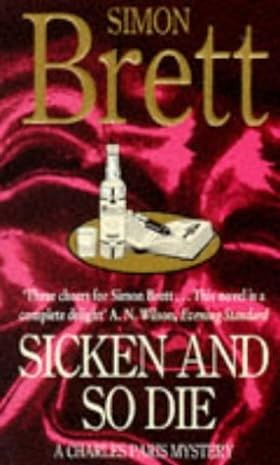
In Charles Paris’ sixteenth mystery, things are going suspiciously well; he and his estranged wife Frances have rekindled their romance, Paris is cast as Sir Toby Belch in a competent production of Shakespeare’s Twelfth Night, which will be touring for several months and giving him a steady paycheck, and he’s actually got his drinking habit under (mostly) under control.
The production of Twelfth Night is going smoothly enough; a current television star and an old movie star are bringing the right kind of attention to the production, and the director, Gavin, is a competent if uninspired, director, and everything is shaping up to be an uneventful, but profitable, circuit around the local and regional Shakespeare festivals.
Charles Paris dreams of playing Sir Toby Belch his way, as Shakespeare intended, when Gavin is stricken with a particularly nasty and almost deadly case of food poisoning. The theatre company hurriedly hired avant-garde director Andrea Redelescu from Romania, who wanted to put his stamp all over theEnglish theatre.
Redelescu and Paris clash almost at once about how the radical changes Redelescu makes to the production and Redelescu’s obsession with the hidden sexual orientations of every character, anachronisms such as t-shirts, and much more. The rest of the cast, initially resistant to Redelescu, is soon under his mesmeric charisma. The play soon thorns Paris’s side, but more of his cast members fall sick due to “food poisoning,” which makes him suspicious.
Depressed, Paris starts drinking again, and after bringing home a castmate to Frances’ apartment and his friend violently vomiting all over her carpet and needing to call an ambulance, two things are clear: his relationship with Frances is over, and someone is poisoning the cast of Twelfth Night.
Paris begins to investigate, breaking into Redelescu’s apartment, where he finds a book on poisons and some suspicious powder. However, on his way to report his findings to the police, he is poisoned by drinking beer from his flask that has been laced with Mercuric Chloride and is violently ill before staggering into a police station.
The police and Paris are too late to save a fellow cast mate from dying on stage during the dress rehearsal, and time is running out for Paris to catch a killer before the curtain rises.
The Review
Sicken and So Die is a pretty bare-bones mystery. Most of the book is concerned with detailing the state of Paris’ various relationships for good or for ill or discussing the different aspects of Twelfth Night.
The deep dive into Charles Paris and Frances’s romantic relationship was not particularly interesting to me- watching an alcoholic husband promise to be faithful to his wife and to control his drinking after twenty years of failing to do so had the predictable outcome of Paris imploding everything because his love of beer is more significant than his wife. I think the author was trying to get the reader to believe Paris’ delusions that he could be a better man and be disappointed, but I think real life has made most people wise to this line by Paris. Also, watching a marriage’s sad, slow, inevitable break-up is not entertaining. Maybe long-time readers of the series are interested in Paris’ marriage, but I was not invested in it.
The Twelfth Night play rehearsals were interesting enough, but nothing took a long time to happen. Several painstaking weeks of rehearsals were detailed before Gavin’s death, which I think was to get the reader invested in Charles Paris’ career-defining role of Sir Toby Belch before Redelescu comes in and remakes Shakespeare in his image.
Redelescu is a comic character, and his obsession with SEX, SEX, SEX! It was funny and definitely true to a specific type of theatre director. Still, again, so much time is devoted to Paris’ clashes with Redelescu that there’s no progress with the mystery. Paris is suspicious of several other food poisonings and strange behaviors on set, and he thinks something criminal is happening. Still, he doesn’t actually do anything until a cast member dies.
The death of his friend spurs him into action, and he does one reconnaissance mission where he rushes to conclusions and then gets himself poisoned even though he knows there is a poisoner on the loose. He returns to the theatre and has several blundering and patently prominent conversations with suspects where he fishes for a confession until the murderer boldly tries to stab Paris with a knife. The kicker: Paris hadn’t even suspected the natural killer.
A mystery where the protagonist doesn’t get around to solving the mystery and then doesn’t even figure out the mystery isn’t a good mystery. The explanation for the murder was thin and uninspired, which was in keeping with the rest of the book. Given that the Charles Paris series has twenty books, I hope I just read one of the duds, but Sicken and So Die didn’t impress me.

 Golden Age of Detective Fiction
Leave a reply to March Wrap-Up – Golden Age of Detective Fiction Cancel reply