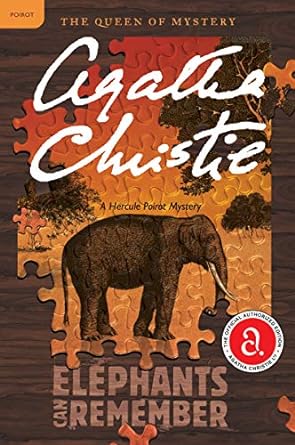
During a literary luncheon, Ariadne Oliver is approached by Mrs. Burton-Cox, mother of Desmond, who is engaged to Oliver’s goddaughter, Celia Ravenscroft. Mrs. Burton-Cox expresses doubts about the true circumstances surrounding the deaths of Celia’s parents. Over a decade ago, Margaret and General Alistair Ravenscroft, close friends of Oliver, were found dead on their estate, their bodies bearing gunshot wounds and a revolver between them, bearing only their prints. The investigation left uncertainty: was it a double suicide or a murder-suicide? Left orphaned, Celia sought Oliver’s counsel, leading her to seek the assistance of her friend Hercule Poirot.
Poirot and Mrs. Oliver delve into the past, meeting elderly witnesses nicknamed “elephants.” They uncover intriguing details: Margaret owned multiple wigs, their dog bit Margaret before her demise, Margaret had an identical twin with a troubled history, and suspicious incidents surrounded Dorothea, the twin, including her fatal sleepwalking incident. Further, they uncover connections to governesses and a peculiar trip to Lausanne by one of them.
Poirot then investigates the Burton-Cox family, discovering Desmond’s adoption and his unknown birth mother, Kathleen Fenn, an actress with ties to Mrs. Burton-Cox’s husband. Desmond inherits a sizable fortune, held in trust until marriage or maturity, which Mrs. Burton-Cox can gain if he perishes. While suspicions arise about her motives, no evidence suggests she desires her son’s demise. Poirot ultimately unravels the truth about the Ravenscrofts’ demise.
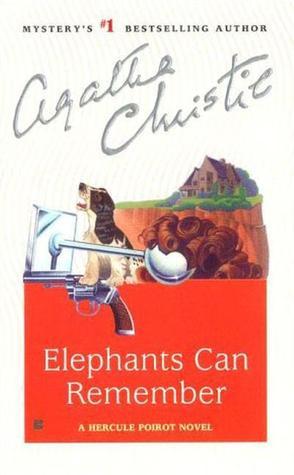
The Review
As an avid reader of Agatha Christie’s works, I approached Elephants Can Remember with high expectations since the David Suchet “Poirot” episode is one of my favorites of the series. I must say, this last Hercule Poirot foray was tired and muddled.
Elephants Can Remember, featuring the iconic detective duo of meticulous Hercule Poirot and the scatterbrained and effusive Ariadne Oliver, offers a delightful reunification of these two beloved characters. While it may not be among her absolute best, Elephants Can Remember still provides a rich look into their long friendship and wildly differing investigative methods. Ariadne Oliver, running hither and thither interviewing “old elephants” who can only half remember the past, and Hercule Poirot, an armchair detective, roused from the comfort of his lodgings only to verify the most critical facts. They banter and criticize each other’s investigative methods, but teaming up is the key to solving this case.
The plot centers around a seemingly straightforward case: the investigation into the death of her parents. There are no apparent reasons for the murder, suicide, or suicide pact, or even clues that definitely point to an outside agent killing them both while they took their evening walk. Everyone who knew the Ravenscrofts has scattered across the globe or died, with memories of the couple growing dimmer with time. Enter Poirot and Oliver, who are tasked with unraveling the truth behind these deaths, which have left lingering questions in the minds of the victim’s daughter, who, as she grows older, feels an increasing desire to “know” what happened.
What sets Elephants Can Remember apart is Christie’s exploration of memory and its unreliability. The title alludes to the notion that memories can be as selective and subjective as an elephant’s. Through the character of Ariadne Oliver, who is grappling with her own memories of a long-ago event, Christie delves into the complexities of human recollection, adding layers of depth to the narrative. Half remembered fragments of mental and physical illnesses, of a dog loving its mistress or a dog that bit its mistress, of children being harmed by each other, or parents; everything is being told through gossip and hearsay, so it is difficult to find the facts out of all the fiction. Christie uses doubling and twinning to heavily muddy what happened on that fateful walk.
So much of Elephants Can Remember lives in a world of unreality that it’s challenging to get one’s bearings, and the book feels slow, ponderous, and elephantine, which may have been deliberate by Christie, but I think not. The book lacks Christie’s usual crisp style, with every sentence moving like a steady motorcoach toward the culprit. Every other sentence repeats what the sentence said before, in a slightly rephrased way, and there’s very little of Christie’s compact dialogue. It lacks her signature distillation. Her famous ability to sum up the heart of a situation, a character, and their motives in a perfectly penned word.
Furthermore, while intriguing, the novel’s exploration of memory occasionally feels heavy-handed and detracts from the overall suspense of the mystery. At times, it feels as though Christie is more interested in dissecting the psychology of her characters than in building tension and suspense. While this introspective approach adds depth to the story, it slows the pacing in places, making certain sections feel overly ponderous.
While the premise of investigating a cold case mystery is compelling, the resolution feels somewhat rushed and lacks the satisfying twist that one might expect from a Christie novel. Many elements are borrowed from her earlier works and used to their advantage in these books. The clues leading up to the reveal are not cleverly planted throughout the dialogue, which is shoddy and sloppy. The final resolution is significantly more evident than in her previous works.
It feels like putting an old friend out to pasture by the end.
There are moments of good cluing, with the vital importance of the four wigs being somewhat intriguing and the banter between Ariadne Oliver and Hercule Poirot stealing the limelight away from the mystery. In fact, I think the entire premise and the solution to the mystery were solid and could have been a great addition to Christie’s works if she had written it earlier, before her mental decline with age and possible dementia. There’s a good story in there, but it never reached her usual heights.
It will be bittersweet for avid fans to see Hercule Poirot and Ariadne Oliver (widely accepted as a stand-in for Christie) work out their final case. It’s unfortunate that theirlast mystery is not as iconic as Hercule Poirot’s final case with his beloved Hastings in Curtain. For new readers of Christie, I recommend starting elsewhere.

Agatha Christie Biography
Agatha Christie, born Agatha Mary Clarissa Miller on September 15, 1890, in Torquay, Devon, England, was one of the most renowned and beloved mystery writers of the 20th century. Her life story is as intriguing as the mysteries she penned.
Christie’s passion for writing emerged early in her life. She began crafting stories as a child, influenced by her mother’s storytelling prowess. Despite her natural talent, she faced initial rejection from publishers, but her determination persisted.
In 1914, Christie married Colonel Archibald Christie, an aviator in the Royal Flying Corps. During World War I, she worked as a dispenser and a nurse, gaining valuable insights into poisons and medical procedures that would later feature prominently in her novels.
Her breakthrough came with her first novel, “The Mysterious Affair at Styles,” published in 1920. This book introduced one of her most famous characters, the Belgian detective Hercule Poirot. Poirot’s meticulous deductive skills and quirky personality endeared him to readers worldwide.
Over the following decades, Christie’s literary output was prolific, with numerous novels, short stories, and plays. She created other iconic characters like Miss Marple, the astute elderly spinster, and Tommy and Tuppence Beresford, the adventurous couple. Her novels often featured intricate plots, red herrings, and surprising twists, captivating readers with their suspenseful narratives.
In 1926, Christie experienced a personal crisis when her marriage to Archibald Christie ended in divorce. During this time, she famously disappeared for eleven days, sparking a nationwide search. She was eventually found at a hotel in Harrogate, Yorkshire, registered under the surname of her husband’s mistress. The exact circumstances of her disappearance remain a mystery, fueling speculation and inspiring various theories.
After her disappearance, Christie continued to write and achieved even greater success. She remarried in 1930 to archaeologist Max Mallowan, with whom she shared a passion for travel and exploration. Christie drew inspiration from her travels, setting many of her stories in exotic locales.
Her works have been translated into numerous languages and adapted into films, television series, and stage plays. She received numerous accolades for her contributions to literature, including being appointed a Dame Commander of the Order of the British Empire (DBE) in 1971.
Agatha Christie passed away on January 12, 1976, leaving behind a rich legacy of mystery and intrigue that continues to captivate readers worldwide. Her influence on the mystery genre is immeasurable, and her works remain timeless classics, cherished by generations of readers.


 Golden Age of Detective Fiction
Leave a comment