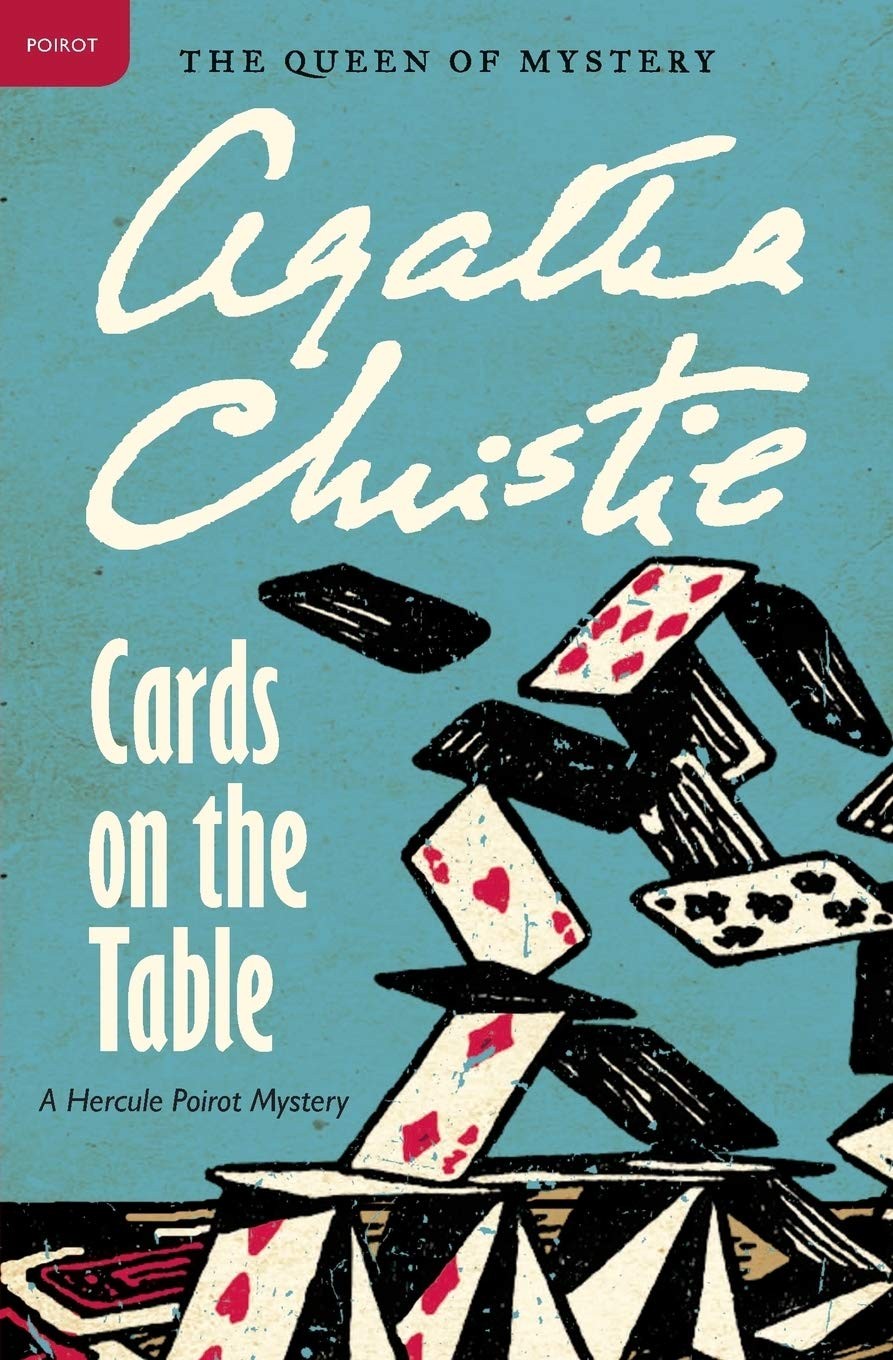
I’m continuing my #20booksofsummer24 challenge hosted by Cathy @746books with a gem of golden-age detective fiction: Cards on the Table by Agatha Christie, published in 1936. Hercule Poirot, Superintendent Battle, Colonel Race, and Ariadne Oliver team up to solve the murder of Mr. Shaitana, who hosted a party with four suspected murderers.
Plot Summary:
Mr. Shaitana, a flamboyant collector, encounters Hercule Poirot at an art exhibition and boasts about his unique collection. Unlike typical artifacts, Shaitana collects criminals who have evaded justice. Intrigued, he invites Poirot to a dinner party to meet them.
Among Poirot’s fellow guests are three crime professionals: secret serviceman Colonel Race, mystery writer Mrs. Ariadne Oliver, and Superintendent Battle of Scotland Yard. Also present are four people Shaitana suspects to be murderers: Dr. Roberts, Mrs. Lorrimer, Anne Meredith, and Major Despard. Shaitana subtly taunts each suspect with comments that only they understand.
The guests separate to play bridge, with the professionals in one room and the suspected murderers in another, where Shaitana relaxes by the fire. As the evening ends, Shaitana is discovered dead, stabbed with a stiletto from his collection. All the suspects are under suspicion, as each had opportunities to move around during the evening. Superintendent Battle leads the investigation, agreeing to let the other professionals conduct their inquiries. Poirot uses the bridge scores to infer each suspect’s playing style and personality.
The investigators delve into the suspects’ pasts. One of Dr. Roberts’ patients died of anthrax after accusing the doctor of misconduct. Major Despard had guided a botanist through the Amazon, who was rumored to have been shot. Anne’s housemate, Rhoda Dawes, tells Mrs. Oliver that an older woman Anne worked for died after mistaking hat paint for syrup of figs. Little is known about Mrs. Lorrimer’s husband, who died twenty years earlier.
Mrs. Lorrimer confides in Poirot that she has a terminal illness and wishes to confess to the murders of her husband and Shaitana. Poirot doubts her capacity for spontaneous murder and suspects she is protecting Anne. Mrs. Lorrimer reluctantly reveals she saw Anne commit the crime but sympathizes with the young woman. The next day, Despard, Roberts, and Anne receive a suicide note and confession from Mrs. Lorrimer. Battle informs Poirot that Dr. Roberts found Mrs. Lorrimer dead from an overdose.
Poirot, suspicious again, realizes Anne had visited Mrs. Lorrimer the night before. He discovers Mrs. Lorrimer could not have sent the letters due to her time of death. Knowing Rhoda is in danger because of her knowledge of the syrup incident, Poirot, Battle, and Despard rush to Rhoda’s cottage. They find Rhoda and Anne in a boat, where Anne tries to push Rhoda overboard but falls in and drowns. Despard rescues Rhoda.
Poirot reveals his findings to Ariadne Oliver and to Superintendent Battle about whether the four guests of Mr. Shaitana’s party were, in fact, murderers, who they filled, and in a final flourish, who had the psychological acumen to kill Mr. Shaitana. Poirot’s biggest clue was in the cards.

The Review
I recently read Cards on the Table by Agatha Christie, and I must say, it’s a fascinating and intricately woven tale that kept me hooked from start to finish. The story’s unique premise centers around a dinner party hosted by the flamboyant Mr. Shaitana, who boasts a macabre collection—not of artifacts, but of people he believes to be murderers who have escaped justice.
One of the standout features of this novel is the use of four different investigators, each bringing their strengths and perspectives to the table. With his keen psychological insights, Hercule Poirot leads the charge, accompanied by Superintendent Battle of Scotland Yard, secret serviceman Colonel Race, and the charming mystery writer Mrs. Ariadne Oliver. The interplay between these characters is delightful, and watching them work individually and collaboratively adds a rich layer to the narrative.
The psychological elements in this story are particularly compelling. Christie masterfully delves into the minds and motives of her characters, making each suspect complex and intriguing. Anne Meredith stands out as a sly and conniving young woman, adept at manipulating those around her to steal what she wants, which is only revealed through a cleverly laid ploy by Poirot.
In stark contrast, Mrs. Lorrimer exudes a calm, calculating demeanor, her sharp mind always one step ahead. Poirot correctly surmises that if she is killed, he will find out only by her lips. She’s a striking, possessed character, but I wished the circumstances of her murder were woven more into the story’s narrative.
Major Despard’s storyline is also gripping, as he is forced into a position where he must kill, bringing a raw and human element to his character. He is hounded by the lovesick wife of the man he accidentally shot due to her passion, and the whole affair could have had a comical air if not for Despard’s deadly, severe, and frank countenance.
Dr. Roberts is followed by the suspicious death of a husband and wife, patients of the doctor. The husband was poisoned by anthrax, and the wife was killed on a pleasure trip to the Middle East.
Poirot correctly summarized that their essential natures are born out of bridge playing. His interviewing style changes based on their nature, and he finds the truth about each murderer and the crimes they have gotten away with one by one.
Superintendent Battle is the central police presence on the case, and he quietly researches their alibis and digs through employment records, rumors, and inconsistencies. Most characters think he is their main adversary and are tight-lipped against this wooden, unimaginative man. Having not given anything away, they are more conversational, unguarded, and liable to forget their stories when approached by Poirot. Ariadne Oliver, whose scatty, comic personality is on full display in The Cards on the Table, creates plots in her head and then chats up suspects, discarding theory after theory and tucking away valuable bits of information. It was a treat to watch all three crimestoppers interact and work together to unmask the four murderers. It’s the Avengers of the Agatha Christie universe.
While the plot is impeccable, I found one slight drawback: Colonel Race’s character was underutilized. Given his background and potential for adding more depth to the investigation, I was disappointed that he didn’t have a more prominent role. However, this minor shortcoming doesn’t significantly detract from the book’s overall enjoyment. I also found it reasonably easy to predict the killer given Poirot’s weighty-handed psychological discussions; what I think was supposed to be a whodunnit was mostly a howdunnit for me.
Cards on the Table is a brilliant example of Agatha Christie’s prowess in crafting a compelling mystery filled with psychological depth and engaging characters, whose alliances and backstabbing, lashing out, secretiveness, and a general desire to protect themselves made the book a fascinating read despite the tiny suspect pool. Having four of Agatha Christie’s detectives in the Hercule Poirot oeuvre team up and flex their talents with crisscrossing storylines and investigative techniques and sharing clues made this an engaging read. I highly recommend it to any fans of Agatha Christie, especially readers who are well versed in the Hercule Poirot series.

#20booksofsummer24 Reviews




 Golden Age of Detective Fiction
Leave a reply to The Affair at the Victory Ball by Agatha Christie (1923) – Golden Age of Detective Fiction Cancel reply