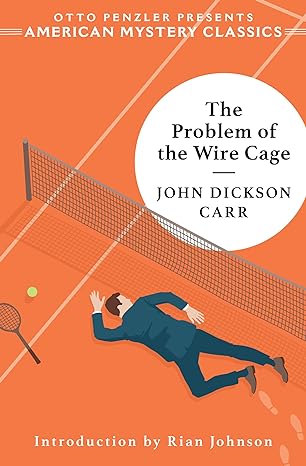
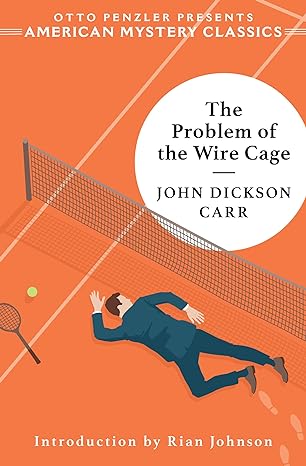
I’m continuing my #20booksofsummer24 challenge hosted by Cathy @746books with The Problem of the Wire Cage, the eleventh Dr. Fell mystery by John Dickson Carr. The Problem of the Wire Cage has been brought to a generation of new readers by Otto Penzler’s imprint, American Mystery Classics in 2024. This new reprint also contains a fantastic introduction by Rian Johnson.
Plot Summary
In a quiet English village, friends are involved in a complex web of relationships and tensions. The central figure is Frank Dorrance, a wealthy and unpleasant man engaged to Brenda White, though she does not love him. Brenda is in love with Hugh Rowland, a more likable character who is not as wealthy as Frank due to being a trial lawyer. The tensions among these characters are evident from the start.
One evening, Frank is found dead on a tennis court. A wire cage encloses the court, and the sand on the court is undisturbed, making it impossible for anyone to enter or leave without leaving footprints. The only footprints found are those of Frank Dorrance himself, leading to his body in the middle of the court. This puzzling scenario leads to the involvement of Dr. Gideon Fell, a brilliant and eccentric detective known for solving seemingly impossible crimes.
The Review
The Problem of the Wire Cage is a gripping mystery that puts a unique twist on John Dickson Carr’s signature locked-room mystery. The initial setup is nothing short of intriguing: who could have possibly killed Frank Dorrance when there are no footprints besides his own (and later, his fiance Branda White’s when she discovers his body)? However, before Carr unveils his ingenious puzzle, he takes his time to introduce the characters and build a palpable atmosphere of suspense.
The mystery begins by setting up the complex love affair between Frank Dorrance, Brenda White, and Hugh Rowland, which reaches a fever pitch one sweltering summer day. Hugh has decided to propose to Brenda one last time; he knows she’ll refuse because if she marries Frank, they will jointly inherit a fortune, and if she doesn’t, Frank will get nothing from a strange codicil to a will. She loves Hugh but feels she cannot refuse a marriage that her guardian has orchestrated since she was young. Hugh proposes, but she refuses, with Frank Dorrance overhearing the whole exchange and enjoying how he has everyone over a barrel. They all go out into the heat to play tennis before the storm breaks.
Elsewhere in the house, Inspector Hadley has come to visit elderly Nick Young and tell him how Frank Dorrance’s dallying has led to a young woman attempting suicide after he spilled wine on a dress she couldn’t afford to clean and nearly cost her her job. The young woman, Madge Sturgess, also has a furious boyfriend who has threatened to kill Frank Dorrance. However, Nick likes Frank’s cavalier and cruel spirit and tries to reassure Inspector Hadley that nothing will happen to Frank; he’ll be married in a week, and his philandering is on its last legs.
The whole emotional turmoil set against the blackening sky, the fierce and angry tennis match that culminates in Hugh Rowland’s defeat, and all of the young characters waiting out the storm feels remarkably like the beginning of a Patricia Wentworth mystery, who is the master of heightened emotions and ill-fated romances sparking a murder. However, Carr creeps into the story while the tennis players, now including their older neighbor woman, Kitty Bancroft, and they all start discussing how they would commit the perfect murder, an idea Nick Young had been expounding on earlier in the week. They also discuss Madge Sturgess’ suicide attempt, which had made headlines, and how a picnic basket full of china was getting moldy and should be taken up to the house.
The storm finally breaks, and Frank and Kitty go to her house. Hugh starts in his car, and Brenda White finally decides not to marry Frank and professes her love to him. She decides she’ll have to break the news to Nick and meet Hugh later that night. Elated, Hugh goes out to his car and starts to drive away when he notices that the tire is punctured; on the way to the shed, he sees Brenda leaning over the dead body of Frank Dorrance, the heavy basket of china beside her. He goes over to help and notices that Brenda’s footprints will make her the prime suspect.
As the story progresses, Hugh and Brenda find themselves in a web of lies, creating an intricate backstory to protect themselves. We follow them as they track down suspects, clash with Inspector Hadley over inconsistencies, and strive to convince others of their version of events. However, their fear of an innocent man being accused ultimately drives them to uncover the true killer, leading to a thrilling climax.
As an investigative team, I enjoyed the Hugh Rowland/ Brenda White duo and was legitimately nervous that their lives would be proven not to hold water. One of them would end up in the docket anyway, but even at their flimsiest, Inspector Hadley doesn’t believe they are the culprit and lets them have their amateurish investigation. We spend so much time with them that it’s easy to forget that an actual amateur detective, Dr. Gideon Fell, is actually on the case.
Dr. Fell, phoned by Hadley after Frank Dorrance is found on the tennis court strangled, comes to investigate but stays primarily silent during the police questioning. Then we don’t see much of his movements because we are with Brenda White and Hugh Rowland, who do exonerate an innocent man and (possibly) lead the killer to his whereabouts; they also track down Madge Sturgess and probe Kitty for an alibi before Dr. Fell gathers everyone together on the tennis court and expounds in his most Poirot-like denouncement.
Dr. Fell feels most at his deus ex machina when he reveals the grotesquely cruel way Frank Dorrance was killed. The methodology is typical of Carr: ingenious, ridiculous, and incredibly macabre, which will appeal to Carr fanatics. In the end, however, Fell’s role feels slightly out of place—and I wonder if he was needed; there were enough other investigators who could have concluded. However, he’s a great detective, and it proves that no one is a better mastermind of puzzles than Dr. Fell.
The ending felt like pulling a rabbit out of a hat, typical of Carr, but the rest of the story felt very unlike him. It was a simple story of greed gussied up with well-told love stories and wildly entertaining characters but lacked the twists, turns, and shocking reveals that usually make up his better mysteries. The Problem of the Wire Cage is a great mystery, but only a good Carr mystery. I think novices to Carr’s work will find The Problem of the Wire Cage more accessible due to its cozy mystery elements, simplified storyline, and easy-to-understand motives, but still get the revelatory puzzle solution at the end. For Carr aficionado, they will like The Problem of the Wire Cage but not rank it as one of his best works

John Dickson Carr
John Dickson Carr (1906-1977) was an American author renowned for his prolific output in the detective fiction genre, particularly known for his mastery of the “locked-room” mystery. Born in Uniontown, Pennsylvania, Carr developed a passion for storytelling at an early age, heavily influenced by classic writers like Arthur Conan Doyle and Gaston Leroux. After studying at Haverford College, he moved to England, where he immersed himself in the golden age of detective fiction. Writing under his own name and several pseudonyms, including Carter Dickson, Carr created a myriad of memorable detectives, most notably Dr. Gideon Fell and Sir Henry Merrivale. His intricate plots and atmospheric settings earned him the prestigious Edgar Award, solidifying his reputation as a leading figure in the genre. Carr’s work remains celebrated for its ingenious puzzles and the clever blending of the supernatural with the rational.

#20booksofsummer24 Reviews



 Golden Age of Detective Fiction
Leave a reply to The Case of the Demented Spiv by George Bellairs (1949) | #20booksofsummer24 | Book 19 of 20 – Golden Age of Detective Fiction Cancel reply