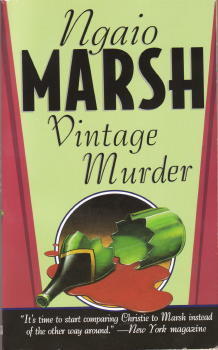
Ngaio Marsh’s Vintage Murder is a more character-driven entry in her Roderick Alleyn series, where the detective finds himself embroiled in a mystery steeped in theatrical intrigue. The lush and scenic backdrop of New Zealand, a setting that will surely captivate your imagination, offers readers a delightful blend of classic whodunit elements and a vivid exploration of the performing arts.
First published in 1937, Vintage Murder is Marsh’s fifth novel featuring the sophisticated and cerebral Inspector Roderick Alleyn of Scotland Yard. On what was supposed to be a relaxing holiday, Alleyn unexpectedly finds himself entangled in an emotionally complex murder case.
Plot Synopsis
Vintage Murder begins with a distinguished London theater company gearing up to tour New Zealand. As they travel the railway to their first playhouse, intimate dramas unfold. The cast comprises the hearty Hailey Hambleton, veteran stage actress Susan Max (who you might remember from Enter a Murderer), stage manager Ted Gasgcoine, the young and untalented Valerie Gaynes, and a smattering of bit players.
The troupe, led by the proprieters: George Mason and Alfred Meyer and Meyer’s wife, famed actress Carolyn Dacres, brings the glamor and drama of the theater to the tiny stages and playhouses of New Zealand. The company is in high spirits, celebrating Carolyn’s birthday with an elaborate on-stage party to which Inspector Alleyn is invited. Gifts are showered on Carolyn, and Inspector Alleyn presents Carolyn with a small, carved jade, a Maori fertility tiki.
The dramatic highlight of the celebration is the planned descent of a massive jeroboam of champagne from above the stage, meant to symbolize a toast to Carolyn’s success and happiness. Alfred and the troupe mechanists practiced the elaborate trick twelve times before the party to total success.
However, the festivities take a dark turn when the jeroboam unexpectedly crashes into Alfred Meyer, killing him in a horrifying spectacle. What initially seems like a tragic accident soon reveals itself to be a calculated act of murder.
Inspector Alleyn, though intending to enjoy a leisurely vacation, is drawn into the investigation by his sense of duty and romantic feelings toward Carolyn Dacres. He joins local police officers: Inspector Wade and Sergeants Packer and Cass. As he delves into the circumstances of the incident, Alleyn discovers a web of secrets, rivalries, and hidden motives within the company and begins to uncover that someone tried to kill Alfred Meyer on the train around New Zealand.
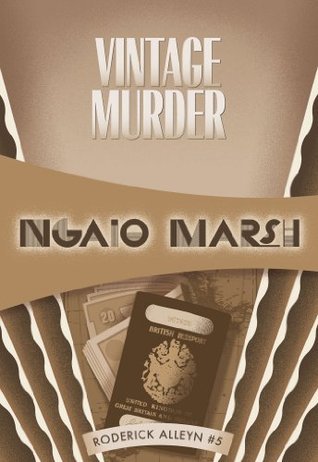
The Review
Inspector Alleyn is joined in his investigation by Dr. Te Pokiha, an educated Maori doctor who works alongside the Inspector as an equal, unlike Fox in the previous books. Through Dr. Te Pokiha’s character, Ngaio Marsh can discuss Maori cultural traditions and how the Maori are faring under British colonialism. Marsh offers a more balanced and critical view of British colonialism than many of her contemporaries, providing readers with a thought-provoking perspective on the issue.
The fertility tiki, a significant Maori cultural artifact, is found at the scene of the crime. This discovery becomes a central aspect of the plot, leading Inspector Alleyn and Dr. Te Pokiha to discuss the complex relationships that the British and Maori have with New Zealanders. These discussions, which are facilitated by the tiki, provide a deeper understanding of the cultural dynamics at play in the Book.
Inspector Alleyn’s relationship with the New Zealand police is more fraught. Although not separated by a common language, they are separated by common usage, leading to more gaffs and tension than usual. The New Zealand police, who are well versed in Alleyn’s exploits, play a significant role in the investigation, reacting partly in hero worship and partly with nervous inferiority. This dynamic provides a more comprehensive view of the investigative process.
Marsh also ribs the fake hearty New Zealand attitude and lays bare that the typical New Zealander, while friendly with their Maori neighbors, does not trust them. The casual racism of the average New Zealander is laid bare and shocks Alleyn (and the modern reader) from time to time. There are a lot of subtle jabs and simmering friction between the three cultures throughout the book.
Inspector Alleyn, known for his erudition and well-placed barbs, is a little out of sorts as he attempts to make professional inroads. He fairs better with the acting troupe- with whom he has experience- but is in danger of having his mild, mannered traveler persona blown by constant small references to his profession. This situation forces him to adapt and evolve, providing readers with a deeper understanding of his character development.
Most of Alleyn’s detective work is done through alibis- which are standard throughout the novel- except with Carolyn Dacres- with whom he is in a bit of puppy love. Tender and embarrassed as a schoolboy, he does his duty and questions her, but a man under the policeman is fully exposed.
Throughout the questioning, Alleyn zeroes in on one particular character and then spends much time figuring out how it was done. There are excellent minutiae of the mechanics of the champagne drop early on, which gives way to minutes about the literal space of the stage- which, while intriguing, would have served the reader better with a map or diagram.
I was hoping that maybe there would be a final twist and one of the rather underwritten secondary troupe characters would burst to center stage and add a final flourish to the mystery, especially since there’s a smaller-scale mystery of who stole money from the spoiled and vain Valerie Gaynes. However, this doesn’t come to pass, and the mystery is a bit more bland than in Marsh’s other books.
Vintage Murder is a good mystery whose primary focus is giving Inspector Alleyn some much-needed depth and humanity. The theatre troupe mystery is ripped from Marsh’s life in a traveling theatre company. Vintage Murder is imbued with Marsh’s love for her native New Zealand, its peoples, cultures, and messy history.



Leave a comment