
Welcome, readers, to my first review of my #20BooksofSummer2025 reading challenge. You can read more about the 20 books I picked and how to participate if you’re interested in my introductory post here. I am excited to join in the 20 Books of Summer this year, hosted by AnnaBookBel and Emma at Words and Peace.
Introduction
Today, I’ll be reviewing Death of an Airman by Christopher St. John Sprigg —a new author to me. Sprigg’s fascinating career as a journalist, mystery writer, technical author, pilot, and political activist was tragically cut short at age 29 when he died in battle fighting in the Spanish Civil War. Death of an Airman features his golden age detective, Inspector Bray, and a rather unique amateur detective: Australian Bishop, Dr. Marriott, in a high-flying aerodrome mystery.
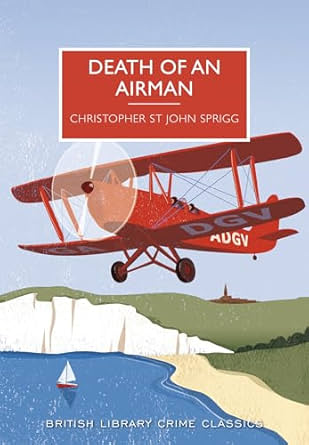
The Plot
Set in the unique backdrop of the Barton Aero Club, Australian Bishop Dr. Edwin Marriott, on a sabbatical in England, is determined to fulfill his lifelong dream of learning to fly. His fascination with the vibrant personalities at the aerodrome is cut short when flying instructor George Furnace crashes and is found dead in a field, sparking initial speculation of a misadventure.
Dr. Marriott, who witnesses the aftermath of the crash, is not convinced that George Furnace’s death was a mere accident. The discovery of a suicide note shortly after the collision seems to confirm a tragic end, but this theory is shattered by two startling revelations: George Furnace was shot in the head, and he died a day before the crash.
Questions swirl around George Furnace’s demise, and Inspector Creighton and Inspector Bray are tasked to investigate whether Furnace died by suicide or murder. While the police are acting along official channels, Dr. Marriott, a mild-mannered man, moves among the five amateur flyers, each with their own complex set of rivalries, friendships, and deepest secrets.

The Review
Death of an Airman is an easy summer read that hums along so seamlessly that it makes the reader almost forget the incredible amount of craftsmanship that created it. The technical knowledge of flying and airplanes that underpins the entire setting at the aerodrome is not just superb, but also fascinating. Christopher St. John Sprigg, a pilot who had written several technical pieces about flying, manages to weave his knowledge into the book in an inviting way, which makes the reader curious about flying and not get bogged down in the technical turns of phrase that alienate the reader and slow down the plot.
Christopher St. John Sprigg is also incredibly gifted in creating dynamic characters: there’s a well-meaning, but rather bulldozer-like woman, whose chief ambition is to start an aeronautical arm of the Brownies called the Aeries, whose terrorizing an entire group of pilots into taking flight rather than talking to her is a notable example. There’s a woman flyer named Sally Sackbut (an unfortunate name) who is fair, and a great presswoman, the owner of the aerodrome, Lady Laura, and a rather timid, amateur flyer named Thomas Vane, a well rounded flyer named Captain Randall and a cantankerous engineer named Andy Ness all populating the world of the aerodrome. They all have distinct and discordant personalities that clash and complement each other constantly, making the reader feel deeply engaged and connected to the story.
These characters feel like a snapshot in time, emerging at the birth of amateur aviation for sport and the beginnings of aviation for commercial purposes. There are sporting exhibitions and frank discussions about how particular individuals can become celebrities if they have the right look and story, even if their talent is somewhat lackluster. There is also a rather interesting underlying theme of how women are pushing aviation forward into new frontiers beyond its traditional usage in warfare, both for good and for ill.
It’s in the middle of this simmering pot of personalities and burgeoning realization of dreams that George Furnace dies. Death of an Airman does an excellent job of settling the reader into uncertainty- was George Furnace murdered or did he commit suicide and builds up a convincing case on both sides, depending on the way the wind blows.
This highly charged atmosphere has led to several love affairs- some more illicit and sordid than others and rumors surrounding George Furnace and his potential involvement provide suspects and motivations for who might want him dead. However, George Furnace isn’t the only person pursuing love at the aerodrome.
As the story progresses, the police uncover sordid love affairs, drug smuggling, and the nastier side of aviation, piloted by greed and ambition. Inspector Bray and Crieghton are somewhat run-of-the-mill whodunnit policemen, perfectly serviceable, with Bray having a shade more characterization, crafty intelligence, and humor than his bland counterpart. I don’t know if Bray appears in any of Christopher St. John Sprigg’s other mysteries, but I would be interested to follow him in other books.
Another flaw in the story is Dr. Marriott’s curious absence from the middle of the story. He spots the initial clue that sets the investigation in motion and has a darkly comic role as a father confessor in the death-defying final. However, his investigation doesn’t propel the plot forward in the middle, and it languishes a bit, with only the relatively dry police procedural moving things along. It would have been more engaging if Dr. Marriott had been more actively involved in the investigation, driving the middle section with more intention. His relatively mild personality is somewhat overwhelmed by all the rampant suspicion and his bombastic suspects.
However, whatever morass the middle section briefly finds itself in is thrown off by a vigorous and dizzying ending set piece, complete with moral stakes and mortal peril, which is not just fun but also deeply satisfying. The book ends with a rather storybook love affair between Dr. Marriott and one of the ladies at the aerodrome in contrast to several secret affairs that ultimately led to George Furnace’s death, leaving the reader feeling fulfilled and content.
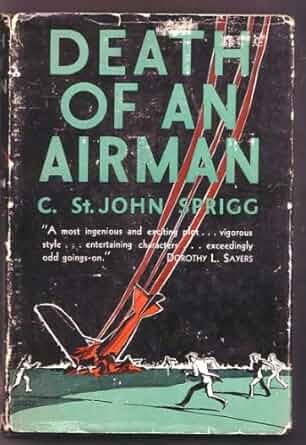
Final Thoughts:
Death of an Airman is an enjoyable romp, even if all the investigative leads didn’t live up to their potential due to weaker characterization and limited crossover between the three investigators, which spread the clues a bit thin. What Death of an Airman lacks in propulsive investigators, it makes up for in dynamic characters, a truly mystifying mystery, and some truly gripping flying set pieces. Moreover, the book provides an insightful commentary on the origins of aviation, examining how it evolved from a niche hobby to a popular and competitive field, as well as the societal transformations it brought about.
About The Author: Christopher St. John Sprigg

Christopher St. John Sprigg (1907–1937), also known by his pseudonym Christopher Caudwell, was a multifaceted English writer, journalist, poet, and Marxist thinker. His brief yet prolific career spanned detective fiction, scientific journalism, and Marxist literary criticism, culminating in his untimely death during the Spanish Civil War at age 29.
Sprigg authored several detective novels characterized by wit and inventive plotting. Notable works include Crime in Kensington (1933), The Perfect Alibi (1934), and Death of an Airman (1934). These novels, often featuring recurring characters like Charles Venables and Inspector Bray, were well-received and are considered part of the Golden Age of detective fiction. Dorothy L. Sayers, a prominent figure in the genre, praised his work.
Sprigg co-founded an aeronautical publishing company with his brother. He wrote technical books, such as The Airship: Its Design, History, Operation, and Future (1931), and contributed articles under various pseudonyms, including “Arthur Cave” and “Icarus.”
In 1935, Sprigg joined the Communist Party of Great Britain and adopted the pseudonym Christopher Caudwell. Under this name, he produced significant Marxist works, including Illusion and Reality: A Study of the Sources of Poetry (1937), The Crisis in Physics (1939), and Studies in a Dying Culture (1938).
Driven by his political convictions, Sprigg volunteered for the International Brigades during the Spanish Civil War. He arrived in Spain in December 1936, trained as a machine-gunner, and became a political delegate. Tragically, he was killed on February 12, 1937, during the first day of the Battle of the Jarama Valley.
While initially remembered for his Marxist writings, recent reprints of his detective novels, such as “Death of an Airman” by the British Library in 2015, have rekindled interest in his fiction. Sprigg’s dual legacy as both a crime novelist and a Marxist intellectual remains a captivating force for readers and scholars alike.



 Golden Age of Detective Fiction
Leave a reply to gaodf Cancel reply