
This week, I’ll be reviewing a selection of cat-themed short stories and books for #ReadingtheMeow2025. Most of my picks are from the Golden Age of Mystery fiction, which is set between the two world wars. You can learn more about how to participate or learn more about what I’ll be reviewing this week by checking out my introductory post here. You can read my first review of #ReadingtheMeow2025, The Strange Case of Sir Arthur Carmichael, here. Thank you to Literary Potpourri for hosting this event again!

The Cyprian Cat
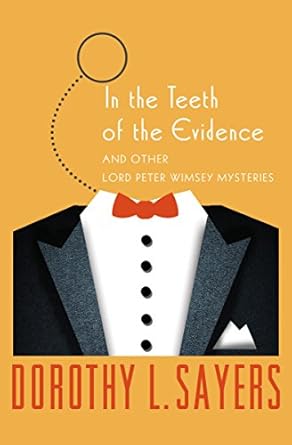
“The Cyprian Cat” is the 17th and last entry in the Dorothy L. Sayers short story collection, In the Teeth of the Evidence, published in 1939. In this eerie, supernatural story, an unnamed man recounts to his solicitor, Harringay, how his pathological fear and revulsion of cats led him to accidentally shoot and kill his best friend’s wife, Felice Merridew, while vacationing at a nearby inn.
The Plot
,I fired one shot and one shot only and that was at the cat. It’s funny that one should be hanged for shooting at a cat. – In The Teeth Of the Evidence, pg. 178.
The unnamed narrator begins his account to his attorney, Harringay, explaining the events that led to his arrest. But the story truly begins years earlier, when he and Mr. Merridew met at school, attended university together, and remained in contact through occasional visits and regular letters despite growing geographic distance.
The narrator is surprised and unsettled when, at forty, Mr. Merridew marries the beautiful Felice, fifteen years his junior. Believing they were both confirmed bachelors, the narrator struggles to reconcile this unexpected change.
A year later, Merridew invites him to his estate to meet Felice. On the train down, the narrator shares a carriage with a cat in a basket, which unnerves and repulses him. He distracts himself by observing a pretty woman in the carriage—who, to his shock, turns out to be Felice Merridew.
Still disturbed by the encounter with the cat, the narrator checks into a local inn. That night, he is kept awake by cats playing in the garden, including a large tabby—referred to as the Cyprian Cat—that climbs the wisteria to his window. Horrified, he shoos it away and shuts the window, despite the oppressive summer heat.
During the days, he visits the Merridews, intrigued by Felice’s fear of running water, which she attributes to a near-drowning in childhood. As Mr. Merridew works at his mill, the narrator and Felice spend long hours together, driving through the countryside. She sunbathes while he enjoys her company.
At night, however, he is haunted by cats—up to fifteen prowling the garden. The Cyprian Cat repeatedly attempts to perch on his windowsill. He learns the innkeeper feeds the cats liver, explaining their numbers. Desperate for relief, he requests a new room but is told none are available.
Disturbed, he buys a revolver, claiming he intends to shoot at the cats. The gun seller warns that the locals revere cats, and harming them is considered bad luck.
One stormy night, the narrator becomes convinced the house is overrun with cats. He hears them meowing throughout and, during a lightning flash, sees them watching from the garden wall. Suddenly, they vanish.
That same night, Merridew rushes in, frantic—Felice won’t wake. In her bedroom, she lies naked, pale, and unresponsive. The narrator helps warm her, noticing a mole on her breast that seems sinister. As they work, the Cyprian Cat claws at the window. The narrator tries to chase it off, but Merridew urges him to focus on Felice. When Merridew leaves to fetch a doctor, the narrator searches for brandy. The cat, hovering at the door, eventually walks away—and Felice suddenly awakens, disoriented. Feeling foolish, the narrator returns to his room.
The next day, relations are cordial again. They enjoy a picnic, but that night, the narrator cannot sleep. When he sees the Cyprian Cat on his windowsill again, he fires his revolver, chases the cat down the hall—and finds Felice standing in the doorway, swaying, her bare breast stained with blood, before she collapses dead.
Moments later, Mr. Merridew finds them, with a trail of blood leading from the narrator’s room to Felice’s body. The narrator insists he shot the cat, not Felice. But no one—not Mr. Merridew nor the innkeepers—can find the cat’s body. In fact, they deny any such cat ever existed.
The Review
The strength of “The Cyprian Cat” lies in its possibly unreliable, psychologically disturbed narrator, whose obsessive fear of cats may extend to more profound mental instability. The reader is left to question the truth of his eerie tale—did he murder Felice Merridew, or was he framed by her husband, Mr. Merridew, who may have poisoned and then shot her for unknown reasons?
Felice is portrayed with feline qualities—her name, love of sun, and aversion to water—suggesting she may be possessed by the titular cat. But since everything is filtered through the narrator’s warped perspective, who assigns cat-like traits to nearly everyone, this interpretation is suspect.
A more grounded reading suggests the narrator is disturbed and sexually obsessed with Felice, jealous of her marriage, and ultimately kills her in a psychotic breakdown, confusing his hatred of cats with his desire for her.
The story’s ambiguity, dense subtext, and the narrator’s paranoia—seeing sinister intent in mundane cat behaviors—blur the line between delusion and reality. His insistence that his relationship with Felice was platonic is unverified, and the silence that follows his plea for corroboration only deepens the mystery: is he a deluded killer, or the perfect scapegoat?
Final Thoughts
I re-read “The Cyprian Cat” several times before writing this review and really enjoyed the purposeful ambiguity of the text. Did the narrator shoot at a cat? Was the Cyprian cat a delusion or the spirit of Mrs. Merridew? With so many possible interpretations, “The Cyprian Cat” is endlessly readable.
I really enjoyed Sayers’ foray into psychological horror and hope that she returns to this genre again. I haven’t read too many of Sayers’ short stories, but “The Cyprian Cat” makes me want to dive into her numerous short story collections.



 Golden Age of Detective Fiction
Leave a reply to Hanging by Hair by Clifford Witting (1950) | #ReadingtheMeow2025 – Golden Age of Detective Fiction Cancel reply