It’s the first of December, and I’m definitely getting into the Christmas spirit- Michael Buble’s Christmas album is playing on repeat, sugar cookies are baked, and I’m ready for a good old-fashioned Christmas-themed mystery
#2025Christmas Reading Challenge
I’ll be participating in the 2025 Christmas Reading Challenge hosted by That Happy Reader and aim to review 20 Christmas Mysteries by the end of the year. I’m cheating a little bit and have included several Christmas short stories that I want to get off my TBR-because there’s nothing like cozy holiday mysteries to get into the Christmas spirit!
The rules of the challenge are flexible, and if you want to participate, choose 10, 15, or 20 Christmas-themed books and review them before December 31. You can read the complete list of rules here. I’m excited to see what Christmas books you’ll pick for your own Reading Challenge introductory post here.
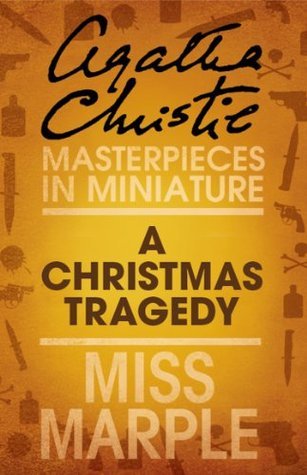
I’m kicking off my #2025ChristmasReadingChallenge with a story I know I’ve read before: “A Christmas Tragedy” by Agatha Christie. But I had no recollection of the story when I picked it up again this year, and I look forward to rediscovering that cozy feeling.
Publication History: The Hat & the Alibi, or is it The Thirteen Problems, or is it A Christmas Tragedy?
“A Christmas Tragedy” was first published in the UK in 1930, under the title “The Hat & the Alibi” in The Story Teller. It was later included in the short story anthology, The Thirteen Problems, where Miss Marple and her circle of friends discuss thirteen suspected murders or mysteries that they have been acquainted with in their lives.
The Thirteen Problems was published in the UK in 1932. An American release followed later that year- and of course included a name change- The Thirteen Problems became The Tuesday Night Murders across the pond.
Synopsis
After several weeks of “the men” recounting their murder mysteries, Henry Clithering jibes the group, saying that “the women” haven’t been keeping up their end of the bargain, and pleads with Miss Marple to recount her murder story, knowing it will be a good yarn.
Miss Marple explains that many years ago, just before Christmas, she was staying at the Keston Spa Hydro, where she met a married couple named Jack and Gladys Sanders. Upon their initial encounter, Miss Marple suspects Jack wants to kill his wife for financial gain.
She begins following the couple, and after a shopping trip, the three of them get on a tram back to the spa. She watches Jack trip and fall into his wife, nearly knocking her from the moving tram- and almost killing her. Miss Marple reasons that Jack, who served on a ship, wouldn’t lose his balance on a moving tram. What was once only a suspicious feeling is now confirmed. Jack is trying to kill his wife and make it look like an accident.
Miss Marple contrives to get Jack to attempt to kill his wife in a way of her choosing, but her plan is foiled when Gladys is found dead in her room with a blow to the head. Gladys Sander’s jewelry is missing, suggesting a robbery, and her husband, Jack, has a watertight alibi.
Jack’s appearance of genuine grief puts a niggle of doubt in Miss Marple’s brain, but a series of small observations- the too small hat, the temperature of the body, among others soon convince her that Jack killed his wife. She realizes that he knew she was trying to trap him and still managed to kill his wife,
Miss Marple and Jack Sanders are locked in a battle of wits as she reconstructs this devilishly clever crime and attempts to avenge Gladys Sanders’s death by bringing Jack to justice.
The Review
“A Christmas Tragedy” showcases Miss Marple’s clever reasoning-she deduces from village life and human nature rather than technical clues. Her intuitive method invites admiration and curiosity about her unique detective style.
Miss Marple’s obsession with where human nature meets crime puts her in a different sphere than the police procedurals that dominated crime fiction at this time. Her desire to trap a criminal and stop a crime before it happens feels a bit silly- and even futile, which she acknowledges in her recounting. Going forward, Miss Marple knows that it’s tough to stop a murder.
When she is eventually thwarted, she knows that there’s no evidence in the traditional sense against him, a clear understanding of morality drives her- justice must prevail. You can see this theme more fully developed in her later full-length mystery, Nemesis.
The deconstruction of the crime is done with excellent economy, and Jack Sanders’s pure genius is on display. The two most significant clues- the hat next to the body and Jack Sanders’ convenient alibi- make the original title of The Hat & the Alibi a more apt title and help point the reader in the right direction.
There is definitely a sense of melancholia and regret as Miss Marple recounts that she had all of the clues necessary to make sure an arrest was made for Jack Sanders as soon as she saw the body- if only she had put together what she really saw in the moment. Her regret is palpable, and she makes sure her audience knows she won’t make that mistake again. And she was right- several of the elements are used again in Murder at the Vicarage.
Wait, I Thought this was a Christmas Story?
So, “A Christmas Tragedy” isn’t really a Christmas story. Sure, the story is set in the lead-up to Christmas, and the tram incident happens after Christmas shopping, but Christmas doesn’t really figure into the story or the mystery’s solution in an impactful way.
I know that the Agatha Christie estate has rebranded “The Hat and the Alibi” as a Christmas story. Still, I much prefer its original title as I think it provides the reader with invaluable clues to solve the murder on their own.
If you’re in the mood for a Christmas short story starring Miss Marple, this isn’t the most satisfying. However, Christie’s other detective, Hercule Poirot, stars in a few Christmas-themed capers: The Adventure of the Christmas Pudding and Hercule Poirot’s Christmas. Sophie Hannah, who has taken over writing Christie’s Poirot, has also put out a Christmas-themed Hercule Poirot full-length novel called Hercule Poirot’s Silent Night to satiate your Christmas mystery needs.
The Verdict
“A Christmas Tragedy” is a really great mystery and a clear portrait of who Miss Marple is and why she solves crimes. She’s clever and shrewd and a far cry from the pink fluffy old lady that she adopts to ingratiate herself with others better.
Several story elements are revisited and expanded upon in her later novels- but this first iteration is brilliantly constructed and well executed. If they had never been touched again, this story would have done them justice.
“A Christmas Tragedy” is a crime fiction classic, if not a very satisfying Christmas story. You can buy “A Christmas Tragedy ” as part of Midwinter Mysteries here.


Agatha Christie Christmas Story Reviews
Hercule Poirot’s Christmas (1938)

 Golden Age of Detective Fiction
Leave a reply to “The Queen’s Square” from Hangman’s Holiday by Dorothy L. Sayers (1933) | #2025ChristmasReadingChallenge | #20BooksOfChristmas | 5/20 – Golden Age of Detective Fiction Cancel reply